Aerospace & aviation
Aerospace Translation Services
We deliver aerospace translation services for AS9100 supply chains: inspection records, material certificates, engineering drawings, and structured maintenance documentation. Our linguists work between English, French, German, and Japanese with the traceability discipline this industry audits for.
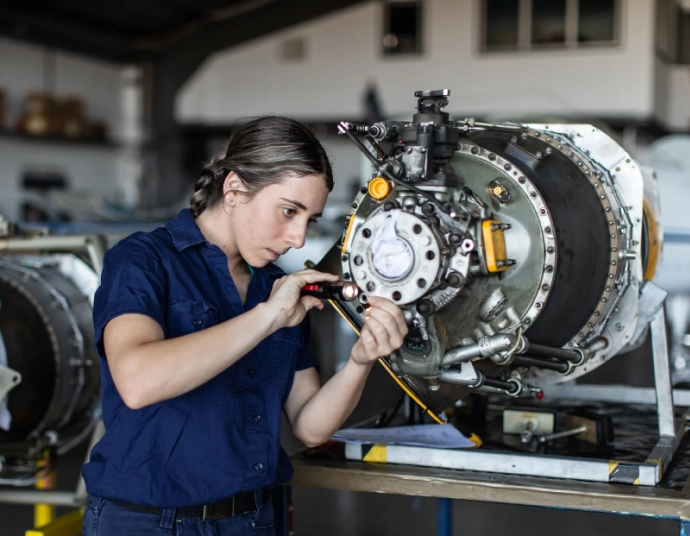
Certificate numbers, heat lots, and serial references carry through translation unchanged, so your AS9100 records chain stays unbroken.
We translate inside structured data modules, respecting DMC codes, applicability, and controlled language rules instead of flattening them into prose.
For defense-adjacent content we assign US person linguists and keep files inside controlled US-based storage, documented for your compliance file.
Aviation regulates in English, but builds in every language
FAA maintenance records live in English, and controllers and pilots share English over the radio. It would be easy to conclude that aviation has no translation problem. The supply chain says otherwise. A single commercial aircraft carries parts from hundreds of suppliers across Europe, Japan, and the Americas, and the documents those parts travel with, the material certificates, test reports, and process specifications, originate in the supplier's language before they ever reach an American receiving dock. US aerospace exports run into the hundreds of billions of dollars, and imports of structures, engines components, and systems flow back just as steadily.
Aerospace translation services sit in that gap between a regulated English cockpit and a multilingual factory floor. Techniwords has served aerospace suppliers and MRO organizations for 15 years from our base in Texas, within reach of the DFW aviation cluster, and every project runs through an ISO 17100-compliant process with independent revision. In an industry where a transposed digit in a heat number can quarantine a shipment, that second pair of qualified eyes is not a formality.
AS9100 runs on records, and records cross borders
AS9100 extends ISO 9001 with the aerospace clauses that make traceability a way of life: configuration management, control of counterfeit parts, first article inspection per AS9102, and product safety. Every clause generates records, and when your supplier base includes companies in Toulouse, Nagoya, and Hamburg, a meaningful share of those records arrives in French, Japanese, or German.
We translate supplier quality records so they can enter your AS9100 system as objective evidence: first article inspection reports mapped to the AS9102 three-form structure, nonconformance reports, concession requests, and corrective actions. Numbers, part identifiers, and revision letters are verified character by character against the source, because aerospace auditors sample exactly those fields. The same discipline applies to inspection report translation, where a dimensional result attributed to the wrong characteristic is worse than no translation at all.
Quality system documentation itself moves too, when a European parent rolls out its manual to a US site or a US supplier submits documentation to a foreign prime. How we handle that document class is covered in depth on this page.
EN 10204 material certificates: small documents, heavy consequences
European mills and forges certify material to EN 10204, and the type matters. A Type 2.2 certificate reports typical results; a Type 3.1 certificate ties the specific delivered batch to its melt with results validated by the manufacturer's independent inspection department; a Type 3.2 adds a third-party witness. American receiving inspectors see these documents in German, French, and Italian every week, stapled to titanium bar stock and aluminum plate.
A mistranslated Type 3.1 certificate can ground a part lot. If the translated chemical composition table shifts a column, or the heat treatment condition is rendered loosely, receiving inspection cannot reconcile the certificate with the purchase specification, and the material sits in quarantine while the clock runs on your production schedule.
We translate mill certificates, heat treatment records, and NDT reports with table structures intact and every value cross-checked. Adjacent to these sit the equipment records your quality system depends on: we support audit files by translating calibration certificates from European and Japanese instrument makers so your measurement traceability survives a surveillance audit without gaps.
S1000D, ATA iSpec 2200, and documentation that is really a database
Modern maintenance documentation is not a book. Under S1000D, content lives in data modules identified by DMC codes, filtered by applicability, and assembled into publications on demand. Civil aviation legacy fleets still run on ATA iSpec 2200 chapters, where the numbering from ATA 21 through ATA 80 is a shared map every mechanic navigates by. Translating this material means working inside the structure: XML elements stay untouched, controlled language rules like ASD-STE100 Simplified Technical English inform how source ambiguity gets resolved, and the translated module must validate against the same schema as the original.
We translate S1000D data modules, component maintenance manuals, service bulletins, and illustrated parts data, delivering valid XML rather than word-processor approximations. Where the program's governing documents are themselves foreign, our translation of technical standards gives your engineers working English versions of the EN, JIS, or AIR standards a purchase order invokes.
ITAR-adjacent work: when the part has two lives
Plenty of aerospace components live near the defense line. A machined housing may fly on both a business jet and a military platform, and once technical data falls under ITAR, 22 CFR 120-130 controls who may see it. Sending an ITAR-controlled drawing to an overseas translator is an export, full stop, and an unauthorized one carries penalties no cost saving justifies.
For controlled projects we staff US person linguists exclusively, keep files in access-restricted US-based storage, and document the handling chain so your empowered official has something to file. When the work is fully military, our defense translation services page describes the stricter environment we apply, including EAR-controlled and CUI-bearing documents.
The documents aerospace teams send us most
Beyond certificates and maintenance data, a consistent set of documents crosses our desk from aerospace clients.
| Document | Typical languages | Why precision matters |
|---|---|---|
| Engineering drawings and notes | French, German to English | GD&T symbols and flag notes drive machining decisions |
| First article inspection reports | Japanese, German to English | AS9102 forms feed directly into customer approval |
| Purchase and process specifications | French to English | Invoked requirements are contractual |
| Supplier audit documentation | Both directions | Findings and evidence must reconcile across languages |
| Maintenance and repair documentation | English to French, Japanese | MRO technicians act on the text directly |
Drawing work deserves a note of its own. When translating engineering drawings we work in the CAD or PDF layer your workflow requires, keep ASME Y14.5 GD&T symbology untouched, and translate only what should be translated: title blocks, flag notes, and process callouts, never dimension values or datum labels.
French, German, and Japanese: the supply chain speaks three languages
French leads our aerospace volume because of the Airbus ecosystem. The A320 family line in Mobile, Alabama pulls a US supplier network into a French-speaking industrial system, and suppliers in the Toulouse orbit send specifications, quality requirements, and audit correspondence that read very differently from schoolbook French. Our French technical translation team handles AIR and NF standards, Safran and Dassault supplier documentation, and the particular vocabulary of French aerostructures.
German covers the other half of the European supply chain: machine tool documentation from the suppliers who equip aerospace machine shops, Liebherr and Diehl component documentation, and DIN-referenced process specs; you can read more here about the third pillar, Japanese, where heavy industry partners build wings and fuselage sections for US programs and share manufacturing engineering documents that assume fluency in JIS conventions. Each language gets linguists who specialize in it for aerospace specifically, not a generalist pool.
Terminology: the vocabulary that exposes an outsider in one sentence
Aerospace language is unforgiving of approximation. A rib is not a frame, a frame is not a former, and a stringer is none of the three, yet a general translator working from French will happily swap nervure, cadre, and lisse into whichever English word feels close. Fastener vocabulary is its own minefield: Hi-Lok, lockbolt, and blind rivet name different hardware with different installation processes, and the French or German source often uses a supplier trade name the translator must recognize rather than transliterate.
Process language cuts even finer. Shot peening and peen forming are different operations with different specs. Passivation, conversion coating, and anodizing follow different AMS documents, and a certificate that says the wrong one contradicts the purchase order it accompanies. Japanese sources add the JIS layer, where a heat treatment condition code has an exact AMS near-equivalent that must be stated, not paraphrased. Even units carry risk: European drawings speak newtons and millimeters while a US shop floor still thinks in inch-pounds, so our rule is to convert only where the client's drawing standard says to, and to flag every case where the source is silent.
Our aerospace termbases encode these decisions once, per client, and every linguist on the account works from them. When a new term appears, it enters the termbase through a documented query to your engineering contact, not through one translator's best guess propagating quietly across two hundred documents.
Commercial space and new entrants raise the documentation tempo
The launch and satellite sector has pulled thousands of new suppliers into aerospace-grade documentation practices, many of them machine shops and electronics houses that never held an AS9100 certificate before. Commercial space programs buy from the same European mills and Japanese component makers as commercial aviation, so the same French process specs and German material certificates land on much younger quality departments. The difference is tempo: launch cadences compress supplier qualification into weeks, and a certificate translation that takes ten days breaks the schedule.
We support these teams with fast-turn certificate and specification translation on standing terms, so a purchasing agent can forward a supplier PDF and get records-grade English back inside two business days without renegotiating a quote each time. For new entrants building their documentation systems, we also translate the European and Japanese standards their primes invoke, which shortens the learning curve for engineers who would otherwise be working from machine-translated fragments of an EN document.
Advanced air mobility follows the same curve one step behind. eVTOL developers source motors, battery systems, and composite structures from suppliers in Germany, Japan, and Korea, and their certification programs generate document flows that look like a compressed version of a commercial aircraft program. Teams that set up disciplined translation early, with a termbase and a standing turnaround agreement, avoid the qualification bottlenecks that hit programs treating each foreign document as a one-off emergency. The suppliers are new, but the documentation physics have not changed: the certificate has to reconcile with the spec, in English, before the hardware moves.
AOG pressure, and a process built to hold under it
Aircraft on ground changes everything about a timeline. When an MRO needs a foreign-language repair scheme or a component manual chapter to release an aircraft, translation measured in days is useless. We run an expedited lane for AOG and short-fuse certification requests: a specialist begins within hours, revision runs in parallel by section, and we deliver rolling updates so your engineer works while we finish. It is the same ISO 17100-compliant workflow, compressed, never skipped.
A recent example shows the ordinary version of this work. A machine shop in Wichita entering the Airbus supply chain received its first purchase package: French process specifications, quality flow-down requirements, and EN 10204 certificate obligations. We translated the package, built a French-English termbase around their processes, and now turn their routine certificate and specification traffic in 48-hour cycles. Membership in ATA and GALA, certified aerospace translators, and fifteen years of records-grade work are what let a shop that size sell into a European prime without hiring a bilingual quality engineer.
Aerospace translation FAQ
Can you translate S1000D data modules without breaking the XML?
Yes. We translate inside the data module, leaving elements, attributes, and DMC identifiers untouched, and we validate the translated module against the applicable S1000D schema before delivery. Applicability annotations and cross-references to other modules are preserved so your CSDB ingests the files directly. Where the source follows ASD-STE100 Simplified Technical English, we apply equivalent controlled-language discipline in the target so warnings and procedural steps keep their one-instruction-per-sentence structure.
How do you handle ITAR-controlled technical data?
Controlled projects are staffed exclusively with US person linguists working under signed NDAs, and files stay in access-restricted storage on US soil for the life of the project. Nothing routes through overseas offices or foreign freelancers, and we provide a written statement of handling for your export compliance file. If your program requires work inside your own controlled environment, our linguists can operate in your systems instead of ours. Tell us at quoting that content is ITAR or EAR controlled so we assign the correct team from the first file.
Do you translate EN 10204 material certificates and mill test reports?
Constantly. Type 2.1, 2.2, 3.1, and 3.2 certificates from European mills are among our most frequent aerospace documents, usually German, French, or Italian into English. We preserve table structure exactly, verify every chemical composition value, mechanical property, and heat number against the source, and keep specification references such as EN, AMS, and ASTM designations unaltered. Receiving inspection gets a document it can reconcile line by line with the purchase order, typically within 24–48 hours for standard certificates.
Can you support an AOG or other urgent situation?
Yes. Our expedited lane exists for exactly this: a qualified aerospace linguist starts within hours of your call, revision runs in parallel section by section, and we deliver rolling partial files so your engineers and mechanics can begin work before the full document is complete. Repair schemes, component manual extracts, and foreign airworthiness correspondence are typical AOG requests. Quality steps are compressed, not skipped: every delivered section still passes independent revision before you rely on it.
How do you guarantee traceability through translation?
By treating identifiers as untouchable data. Part numbers, serial and heat numbers, certificate references, drawing revisions, and specification callouts are verified character by character in a dedicated QA pass, separate from the linguistic review. Translated documents carry the same document numbers and revision levels as their sources, so your AS9100 records chain links cleanly across languages. On request we deliver a bilingual index mapping each translated record to its source file for your audit trail.
What file formats do you work with for drawings and technical data?
Native CAD annotation layers, PDF drawing sets, and the XML formats behind structured documentation, alongside the usual Word, Excel, and InDesign. For drawings we translate title blocks, notes, and callouts while leaving geometry, dimensions, and GD&T symbols untouched, and we can deliver either an annotated PDF or an edited native file depending on your configuration control rules. For S1000D and iSpec 2200 content we return valid, schema-checked files ready for your publication system.
Keep your records chain unbroken in every language
Send us the certificate stack, the French purchase package, or the data module set, and flag anything export-controlled. You will receive an itemized quote within one business hour, with the handling plan and delivery date stated up front.
Get a Free Quote