
Engineering services
CAD Translation Services
Techniwords translates the text inside your DWG, DXF, and other CAD files through an automated extraction and reinjection pipeline, so layers, blocks, attributes, and dimensions stay exactly where your engineers put them. Whether you send ten drawings or five hundred, the set comes back as native CAD files plus matching PDFs, checked sheet by sheet before delivery.
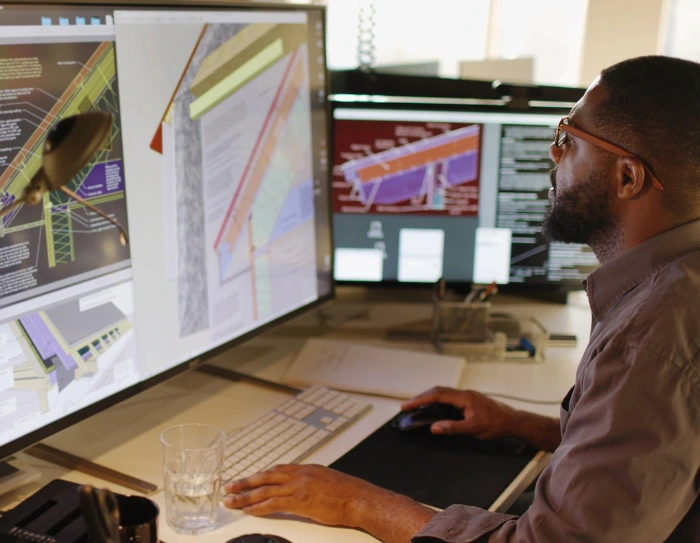
Text is extracted and reinjected by software, not retyped by hand. Blocks, attributes, and xrefs survive untouched, and nothing gets pasted into the wrong entity.
Repeated notes across a 500-sheet set are translated once and propagated everywhere, which cuts both the invoice and the risk of the same note reading two different ways.
Reinjection is automated, approval is not. A checker opens each translated drawing next to the original and verifies placement, overlaps, and legibility at plot scale.
What Our CAD Translation Service Includes
This service takes a set of engineering drawings in native CAD format and returns the same set with every piece of text rendered in the target language: general notes, title blocks, dimension annotations, attribute values inside blocks, text carried by external references, and the legends that make a drawing readable to the crew using it. What the service deliberately does not do is disturb the geometry. Lines, entities, layer structure, and plot settings come back byte-for-byte where the pipeline had no reason to touch them.
We keep this page about the delivery mechanics. For what makes drawing text linguistically tricky, from GD&T callouts to drawing abbreviations, see our pages on CAD file translation and translating engineering drawings, which cover the documents themselves. The typical trigger for the service is a project event: a European machine builder hands a US plant its complete drawing package in German, a plant acquisition comes with two decades of as-built documentation in Spanish, or a US firm bidding overseas must submit its drawing set in the client's language. In each case the unit of work is a batch, not a page, and the process is built around that fact.
Techniwords has run drawing projects for 15 years alongside its document work, with translators who hold engineering specializations and an ISO 17100-compliant process behind every batch, independent revision included.
Extraction and Reinjection: How the Pipeline Works
The worst way to translate a drawing is to open it and start typing. Manual editing inside a CAD viewport is slow, invisible to quality tools, and dangerous: one mistyped attribute or a note pasted into the wrong block and the error ships to a fabricator. Our pipeline removes hands from the file.
- Inventory. The batch is scanned and every text-bearing entity is cataloged: TEXT and MTEXT entities, attribute values, dimension overrides, table cells, and text inside block definitions and xrefs.
- Extraction. The text is pulled into a structured bilingual file, with each string keyed to its exact entity and drawing, so nothing can return to the wrong place.
- Translation in a CAT environment. Linguists work in translation software against your termbase and translation memory, never inside the drawing. Codes, part numbers, and untranslatables are locked.
- Independent revision. A second engineer-linguist reviews the bilingual file before anything is written back.
- Reinjection. Software writes each translated string back to its keyed entity, preserving layer, style, justification, and rotation.
- Fit and font pass. Text that outgrew its space is adjusted by width factor or controlled abbreviation from an approved list, and fonts are remapped where the script requires it.
- Visual check and plot. Each sheet is compared against the source and plotted to PDF for the delivery package.
Because extraction is entity-keyed, block definitions are translated once and update every insertion, and xref text is translated in the referenced file so every host drawing inherits the fix. That is the difference between a pipeline and a very patient person with a keyboard.
What Gets Translated, What Stays Locked
Before a batch runs, we agree on a translate-or-lock decision list, because a drawing mixes text that must change with text that must never change. General notes, material callouts, weld and finish instructions, and legend entries get translated. Part numbers, tag numbers, and equipment codes are locked in the extraction so a translator cannot alter them even accidentally. Standard designations stay in their official form: a reference to DIN EN ISO 13920 or ASME Y14.100 is an identifier, not a phrase, and rewriting it would break the citation your fabricator needs to look up. Trade names and proper nouns follow whatever convention your style guide already uses in manuals, so the drawing and the manual agree.
Title blocks get their own decision. Some clients want field labels translated and values untouched; others need the full block in the target language to satisfy a submission requirement. Both are a settings change in the pipeline, not a manual chore, and the pilot sheets exist precisely to settle these choices on real examples before 480 more sheets follow.
There is also a third option between source and target: bilingual delivery. For plants where a mixed crew reads the same sheet, we can stack the translation beneath the original note or place it on a dedicated layer that toggles with a single command. Bilingual sheets carry more text and need more fitting work, so they price a band higher, but they remove the argument about which language version is authoritative on the shop floor. Inspection teams working to the original while operators read the translation tend to ask for this format by name once they have used it.
Batch Processing: Where Large Drawing Sets Get Cheap
Drawing sets are massively repetitive, and honest pricing should reflect it. A homogeneous set of 500 plant drawings might contain 400,000 raw words of extracted text, of which only 20 to 30 percent is unique. Standard notes repeat on every sheet. Title block labels are identical across the set. Revision table headers never change. Our analysis deduplicates the extraction before quoting: full repetitions and translation memory matches are billed at steep discounts shown line by line in the quote, so you pay full rate only for text that actually needs a translator's attention.
On a recent 540-sheet piping package from a German EPC contractor, deduplication reduced 380,000 extracted words to roughly 71,000 unique weighted words. The client's initial per-word estimate had assumed the raw count. The itemized quote came in at about a quarter of their internal budget figure, and the discount deepened on the follow-up batch because the memory already held the first.
Repetition also protects consistency, which on drawings is a safety property. When the same warning note appears on 300 sheets, propagation from a single approved translation guarantees all 300 read identically. German source sets reward this approach especially well, given how standardized DIN-style notes are across a package; our German technical translation team sees the same twenty note patterns on almost every machinery set that crosses the Atlantic.
Fonts in CAD: SHX, TrueType, and the CJK Problem
AutoCAD's native SHX fonts date from an era of plotters and single-byte characters. They render Latin text fast and thin, but most contain no Chinese, Japanese, or Korean glyphs at all, and the classic workaround, Big Fonts, plots inconsistently across systems and breaks when files move between offices. Send a drawing with Chinese text set in an SHX font to a partner without the same font files, and they see question marks where the safety notes should be.
Our font pass handles this deliberately. For CJK targets we remap annotation styles to TrueType families with full glyph coverage, chosen for legibility at typical annotation heights of 2.5 to 3.5 mm on the plotted sheet, and we embed or ship the font files with the delivery so the drawings render identically on your side. For Latin-script targets we keep your existing SHX styles wherever coverage allows, because preserving the drawing's visual character matters to review teams. Width factors are tuned per style: German runs long and needs room, Chinese runs short and can otherwise look lost inside a large leader box. Every remapping is recorded in a style report included with the batch.
Sheet-by-Sheet Visual Control
Automation moves text reliably, but only a human can judge whether a translated note now collides with a weld symbol or whether a stretched title block entry overlaps the revision cloud next to it. So the final gate is visual, and it is per sheet, not per sample. The checker works with source and target side by side at plot scale and verifies a fixed list: text fitting inside its geometry, no overlaps with dimensions or symbols, correct alignment in tables and title blocks, untouched part numbers, and legibility of the smallest annotation text after any width adjustments.
Findings go back through the pipeline, not into the file by hand, so the bilingual record stays true and the next batch inherits the correction. On a 500-sheet set this check is the largest single block of human hours after translation itself, and we quote it explicitly rather than hiding it. Skipping it is how cheap drawing translation ends up expensive.
Input Formats and What You Get Back
| You send | We work in | You receive |
|---|---|---|
| DWG / DXF (AutoCAD and compatible) | Native files, entity-keyed pipeline | Translated DWG/DXF + plotted PDF per sheet |
| MicroStation DGN | Native or via DWG round-trip, agreed per project | Translated DGN or DWG + PDF set |
| Inventor / SolidWorks drawing files | Via DXF/DWG export of drawing sheets | Translated 2D sheets + PDF; source model untouched |
| Vector PDF plots (no CAD source) | Text overlay rebuild in CAD or PDF layer | Bilingual or replacement PDF set |
| Scanned or raster drawings | Redrawn text layer, scoped separately | Legible translated PDF; optional CAD recreation |
Deliverables always come in pairs: the native CAD file for your engineers and a plotted PDF for everyone else, named to your sheet numbering convention so the set drops straight into your document management system. On request we add the bilingual extraction file, which some quality departments archive as objective evidence of what changed, and which auditors reviewing plant documentation have been glad to see.
Pricing by Drawing, Not by Guesswork
Word rates fit running text badly when the text lives on drawings, so we quote per drawing, banded by text density after deduplication. A sparse fabrication detail with a title block and six notes sits in the lowest band. A P&ID legend sheet or a general notes sheet carrying 2,000 words sits at the top. The quote lists each band, the sheet count in it, and the memory discounts applied, so a 500-sheet project reads as a short table instead of a mystery number. Density banding also lets you cut scope intelligently: clients sometimes drop legend-sheet duplicates or superseded revisions from the batch once they see where the cost concentrates.
Two cost drivers are worth knowing in advance. CJK targets add the font remapping pass described above, typically 5 to 10 percent on the batch. And PDF-only sources cost more per sheet than native DWG, because rebuilding a text layer takes hours that reinjection does not. If a native set exists anywhere in your organization or your supplier's, it is worth the search.
Who Sends Us Drawing Batches
The steadiest flow comes from machine builders and plant engineering. Firms in mechanical engineering send fabrication and assembly packages moving between US shops and European or Asian partners. Design offices working in architecture and BIM send construction document sets for international projects, where the CAD deliverable sits alongside model-based workflows. Energy and process clients send piping, instrumentation, and electrical packages around plant sales and relocations. As an ATA and GALA member agency, we also take drawing work subcontracted by other language service providers whose tooling stops at office documents.
When the drawings travel with manuals, datasheets, or a full handover package, the same termbase drives both streams, so the valve is named identically on the sheet and in the manual. Formatted documents that need page production go through our multilingual desktop publishing team; the rest of the catalog is on this page.
CAD Translation: Questions We Hear Most
Can you handle a batch of several hundred drawings?
Yes, that is the size the pipeline was built for. A typical large batch starts with a pilot of 10 to 20 representative sheets so you can approve terminology, fonts, and layout decisions on real drawings. The remainder then runs in staged deliveries, commonly 75 to 150 sheets per week per language depending on density, with the translation memory compounding as the batch advances. Deduplication across the set means the second half of a large batch is always faster and cheaper than the first.
Do you need native DWG files, or can you work from PDF?
Native DWG or DXF is always better: the pipeline extracts and reinjects text automatically, geometry is never at risk, and per-sheet cost drops. From PDF we can still deliver, either by rebuilding a translated text layer over vector plots or by recreating sheets in CAD for scanned originals, but both routes add manual hours. Before quoting a PDF-only set we always ask whether the native files exist at a supplier or in an archive, because finding them usually saves 30 percent or more.
Do you charge full price for text that repeats across drawings?
No. The extraction is deduplicated before we quote. Identical strings across the set, standard notes, title block labels, and revision headers are counted once at full rate and thereafter at a repetition rate shown in the quote grid. On homogeneous sets of several hundred sheets, unique text is often only 20 to 30 percent of the raw word count, and the itemized quote makes that arithmetic visible. Your translation memory carries the discounts forward to every future batch.
How do you handle Chinese, Japanese, or Korean text in AutoCAD?
Standard SHX fonts cannot display CJK characters, so we remap the affected text styles to TrueType families with full glyph coverage, sized for legibility at your annotation heights, and we deliver the font files and a style report with the batch. Width factors are adjusted because CJK text occupies space differently than the Latin source. Every sheet is then plotted and visually checked to confirm the characters render and fit. Your partners open the drawings and see the text, not question marks.
What turnaround should we expect on a large drawing set?
After the pilot sheets are approved, plan on 75 to 150 sheets per week per language for typical industrial sets, with dense P&ID and general-notes sheets at the slower end. A 500-sheet package into one language commonly runs five to seven weeks including the sheet-by-sheet visual check. Staged deliveries mean your engineers start receiving usable drawings in week two rather than waiting for the whole set, and urgent priority sheets can be pulled forward at intake.