
Quality & regulatory
Inspection Report Translation Services
We translate third party inspection reports, NDT records, and FAT/SAT documentation for American companies that source equipment and fabrications abroad. Weld acceptance criteria, inspector qualifications, and annotated findings arrive in English your quality team can act on the same week.
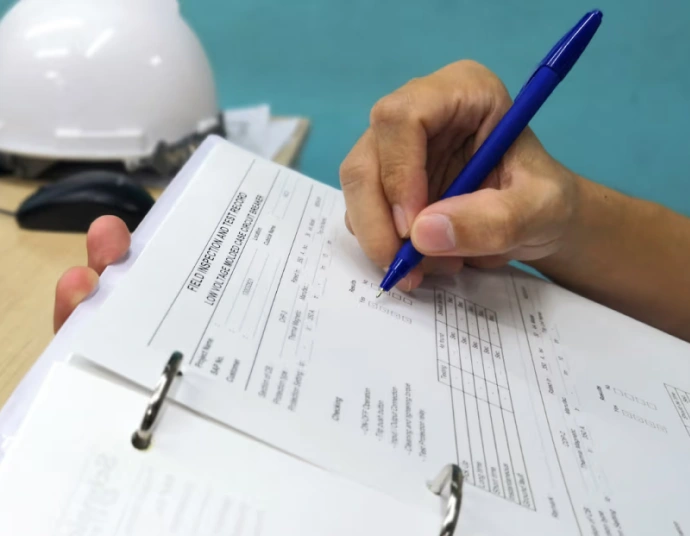
UT, RT, MT, and PT reports are translated by linguists who know what an ASNT Level II signature means and why indication is not the same word as defect.
We never silently map ISO 5817 quality levels onto AWS D1.1 acceptance criteria. Where the source cites a standard, the translation cites it exactly.
FAT reports, release notes, and receiving inspection records are translated on schedules that fit letter-of-credit deadlines and shipment dates, not the other way around.
Why Inspection Report Translation Protects Your Supply Chain
When you buy pressure vessels from Korea, structural steel from China, or castings from India, the inspection report is often the only evidence you will see before the container is loaded. It tells you whether the welds passed, whether the coating thickness met the spec, whether dimensional checks stayed inside tolerance. If that report sits in your inbox in a language nobody on your quality team reads, you are approving a shipment on faith. Accurate inspection report translation turns that document back into what it was meant to be: a decision-making tool.
Techniwords has translated inspection documentation for American importers, EPC contractors, and OEMs for 15 years. Our translators work from the standards your inspectors work from, so a hold point stays a hold point and a conditional release does not soften into an approval. Inspection records are one of more than forty technical document types we cover; you can browse the full list of technical documents we translate to see how this page fits into the wider documentation chain.
The stakes are rarely abstract. A misread acceptance criterion can put a nonconforming girder into a bridge, and a vague translation of a repair recommendation can leave a supplier convinced that no repair was required. Quality managers tell us the same thing again and again: they do not need a rough idea of what the report says. They need the exact finding, the exact criterion, and the exact disposition.
Third Party Inspection Reports: The Document That Releases Your Money
Third party inspection is standard practice in international sourcing. You hire an independent inspection agency to witness tests at the supplier's plant, verify quantities and markings, and issue a report before shipment. Banks tie letters of credit to these documents. Purchasing contracts tie final payments to them. When the TPI agency is local to the supplier, the report frequently arrives in Chinese, Korean, or another source language, with an English summary at best.
A summary is not enough when the details carry the risk. The body of a TPI report lists witnessed hold points, sampling levels, instruments used and their calibration status, and every nonconformity observed. That is precisely the content that gets cut from a courtesy summary. We translate the complete report, including tables, stamps, and marginal notes, so your team sees what the inspector saw. For buyers of cranes, presses, and mining equipment, this work often runs alongside the documentation programs we manage for heavy machinery manufacturers and their supplier networks.
One line can hold up a six-figure payment. Under a letter of credit, banks check shipping documents against the credit's exact wording. An inspection release note translated with the wrong disposition term, "accepted with comments" instead of "conditionally released", can trigger a discrepancy fee, a delayed payment, and a week of calls between three time zones.
NDT Report Translation Is a Specialist's Job
Nondestructive testing has its own compressed vocabulary, and NDT report translation fails quickly in generalist hands. A single page can reference probe angles, couplant, reference blocks, sensitivity settings, and indication lengths, all abbreviated, all meaningful. The people who wrote it hold certifications under ASNT's SNT-TC-1A recommended practice or ISO 9712, and the report's credibility rests on those certification levels being reported accurately. Rendering "Level II UT operator" loosely as "qualified ultrasound technician" strips out the exact qualification your specification demanded.
Here are the methods we translate most often, with the conventions we apply:
| Method | Full name | What the report contains |
|---|---|---|
| UT | Ultrasonic testing | Probe and frequency data, calibration block, scan plan, indication locations and amplitudes |
| RT | Radiographic testing | Film or digital technique, penetrameter/IQI selection, density readings, film interpretation |
| MT | Magnetic particle testing | Magnetization method, particle type, lighting conditions, relevant indications |
| PT | Liquid penetrant testing | Penetrant system, dwell times, developer, bleed-out interpretation |
| VT | Visual testing | Lighting, access, weld profile observations, undercut and spatter notes |
Method abbreviations, equipment model numbers, and weld identifiers stay exactly as written. Everything an American reviewer needs in English gets translated; everything that functions as a traceable identifier does not get touched. That distinction sounds simple. Applied across a 60-page radiography package, it is the difference between a usable report and a compromised one.
Weld Acceptance: AWS D1.1 and ISO 5817 Do Not Line Up
Much of the friction in cross-border inspection comes from welding codes. American structural work is typically governed by AWS D1.1, which states acceptance criteria directly: maximum porosity sizes, undercut limits tied to material thickness, crack prohibition. European and many Asian fabricators work to ISO 5817, which defines quality levels B, C, and D and leaves the contract to pick one. The two systems evaluate some discontinuities differently, and there is no official conversion table between them.
A translator who does not know this will "helpfully" convert one framework into the other, and that is how disputes are born. Our rule is strict: the translation reproduces the standard cited in the source, with clause numbers intact, and any commentary about equivalence appears only if the original inspector wrote it. When a client needs an engineering opinion on whether an ISO 5817 level C weld satisfies their AWS-based purchase order, that question goes to their welding engineer, supported by a faithful translation rather than an improvised one. The same discipline applies when we handle test report translation for mechanical and chemical analysis certificates that accompany welded assemblies.
FAT and SAT Reports: Acceptance Testing on the Clock
Factory acceptance tests compress a lot of documentation into a few days. Your engineers fly to the supplier's plant, or attend remotely, and the FAT protocol, punch list, and final report are generated in the plant's working language while the machine is still warm. Site acceptance testing repeats the exercise on your floor, often with the supplier's foreign commissioning crew writing up results. In both directions, someone has to move fast so that the acceptance decision is made on facts.
We routinely translate FAT protocols before the visit, so your team walks in knowing every test step, and then translate the signed report and open punch items within days of the test. Korean equipment builders are frequent counterparts in this work, and our Korean technical translation team handles FAT packages for presses, battery lines, and semiconductor tooling. Where the punch list feeds directly into startup activities, clients often pair this service with translating their commissioning reports so that the record stays in one language from acceptance through handover.
The Inspection Documents We See Most Often
Inspection is not one document but a family of them, generated at different points between purchase order and installed equipment. Over 15 years we have built glossaries and formatting conventions for each of the recurring types:
- Pre-shipment inspection (PSI) reports covering quantity verification, marking checks, and packing condition before the goods leave the supplier's dock.
- Coating and painting inspection records with dry film thickness readings, surface preparation grades to SSPC or ISO 8501, and holiday test results.
- Dimensional inspection reports keyed to drawing balloon numbers, where a single transposed reference makes a measurement unverifiable.
- Welding inspection logs tracking welder identification, WPS references, and visual acceptance for every joint on a fabrication.
- Container loading and lashing reports that insurers request when transit damage claims arise.
- In-service and periodic inspection reports for cranes, pressure equipment, and lifting gear operating under state or OSHA-driven inspection regimes.
Each type has its own reader. A PSI report goes to purchasing, a coating report to a NACE-certified inspector, a dimensional report to the receiving machinist. We adjust register and layout accordingly, so every reader finds the numbers where they expect them.
When a Supplier Dispute Starts, the Report Becomes Evidence
Most inspection reports are read once and filed. The exceptions are expensive. When cracked welds surface eighteen months after delivery, or a coating fails in the field, the original inspection record becomes the central exhibit in a backcharge negotiation, an insurance claim, or arbitration. At that point, translation quality is scrutinized by opposing counsel, and a loose rendering of "minor surface indications noted, monitoring recommended" can shift responsibility from one party to another.
For dispute work we provide certified translations with a signed statement of accuracy, prepared under our ISO 17100-compliant process with an independent reviser checking every sentence against the source. Clients pursuing a technical root cause alongside the commercial claim often ask us to translate the failure investigation as well; our team covers that under engineering report translation, keeping terminology aligned between the inspection record and the analysis built on it. When the dispute widens into questions about the supplier's quality system, the supplier audit reports we translate complete the evidentiary picture.
Annotated Photos, Stamps, and Handwritten Field Notes
Inspection reports are messy documents. They arrive as scanned PDFs with photographs, arrows drawn on those photographs, red stamps from the inspection body, handwritten measurements in the margins, and tables that were clearly filled in on a clipboard. We translate all of it. Photo captions and on-image annotations are reproduced in a numbered legend or edited directly into the image, depending on what your workflow needs. Stamps and seals are described and translated in brackets so their authority is visible in the English version.
Handwriting deserves a specific mention. Field inspectors write fast, and a rushed hanzi or an abbreviated Korean measurement note can be genuinely ambiguous. Where a handwritten entry cannot be read with certainty, we flag it as illegible or provide the most probable reading with a translator's note, rather than quietly guessing. Chinese-language TPI and mill inspection documents make up a large share of this work, and our Simplified Chinese technical translators read fabrication shop shorthand daily.
How We Translate Your Inspection Reports
Every project follows the same sequence. A project manager in our Texas office reviews the package, confirms which elements are translatable text and which are traceable identifiers, and builds or reuses your term base. A certified translator with inspection and welding domain experience produces the translation. A second, independent linguist revises it against the source. Where the report cites OSHA, ASME, AWS, or ISO references, we verify each one against the published designation, because a transposed digit in a clause number is an error a spellchecker will never catch.
A recent example shows the rhythm of this work. A Gulf Coast equipment importer sent us 43 third party inspection reports from a fabricator in Qingdao, covering UT and MT results on lifting beams, ten days before a scheduled vessel loading. We split the package across two translators sharing one glossary, ran unified revision, and delivered in eight days. The client's welding engineer rejected two beams based on indications that the English summary from the TPI agency had never mentioned. The reports paid for themselves before the ship left port.
Techniwords is a member of the American Translators Association and GALA, and inspection documentation is one of our oldest specialties. Pricing is per source word, with volume tiers for report libraries and framework agreements for companies with continuous receiving inspection needs.
Inspection Report Translation: Frequently Asked Questions
Can you translate third party inspection reports issued in Chinese?
Yes, Chinese TPI reports are the most common request on this page. We translate complete reports from Chinese inspection agencies and fabricators, including witnessed hold point logs, dimensional tables, stamps, and photo annotations. Weld identifiers, drawing numbers, and instrument serial numbers are preserved exactly as written so traceability survives the language change. Most single reports of 10 to 20 pages are delivered within two to three business days, and larger packages are scheduled around your shipment or payment deadlines.
How do you handle NDT abbreviations like UT, RT, MT, and PT?
Method abbreviations stay in their standard form, because UT, RT, MT, and PT are recognized designations in American practice under ASNT terminology. The surrounding technical content, probe data, sensitivity settings, indication descriptions, and evaluations, is fully translated by linguists who work with these reports regularly. Where a source language uses a local abbreviation that has no direct US equivalent, we translate it and note the original form once, so your NDT Level III can verify the method without guesswork.
Can you support a remote FAT with fast document turnaround?
Yes. For remote factory acceptance tests we typically translate the FAT protocol before the test date, so your engineers follow every step live, then translate the signed results and punch list as soon as the supplier issues them. With the protocol already in our translation memory, the report itself moves quickly, often within 24 to 48 hours for standard lengths. That keeps your acceptance decision inside the contractual review window instead of waiting on language.
How fast can you translate an inspection report for an incoming shipment?
A typical third party inspection report of 8 to 15 pages is translated and independently revised in two business days. Genuine emergencies, such as a release note needed for a letter of credit presentation, can be handled in 24 hours when we receive legible source files. For recurring receiving inspection programs we set up a standing glossary and dedicated translator team, which shortens turnaround further because terminology decisions are already made.
What do you do with annotated photos and handwritten notes?
Photo captions and on-image annotations are translated either as a numbered legend keyed to each image or edited directly into the graphics, whichever fits your review process. Handwritten field notes are transcribed and translated; where the handwriting is genuinely ambiguous we mark the passage and give the most probable reading in a translator's note instead of silently guessing. Inspection body stamps and seals are translated in bracketed descriptions so the English reader knows exactly who certified what.
Do you certify translated inspection reports for disputes or customs?
Yes. When a report supports a warranty claim, arbitration, or customs entry, we issue a certified translation with a signed statement of accuracy identifying the translator and the documents covered. The work runs through our standard process, translation by a specialist and full revision by a second linguist, following ISO 17100. Many clients request certification only for the reports entering a dispute file and standard delivery for routine receiving records, which keeps costs proportionate.