
Core industrial language
German Technical Translation Services
We translate machine manuals, engineering drawings, audit reports, and mill certificates between German and English for American manufacturers, with DIN and VDA terminology verified by a second specialist. Every file goes through an ISO 17100-compliant process and comes back formatted for the 30 to 35 percent expansion German adds to your layouts.
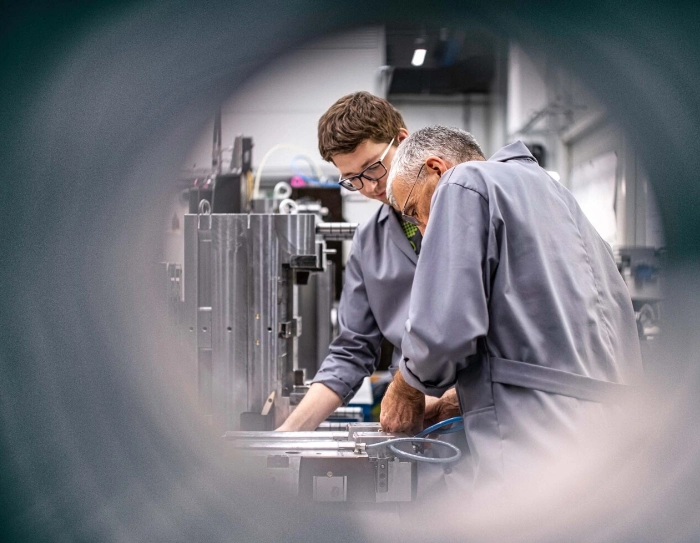
Our German translators work from DIN, VDI, and IATF source references, so a Drehmomentschlüssel comes out as a torque wrench with the correct N·m spec, not a guess.
German OEM audit findings usually carry a short response window. We turn VDA 6.3 reports and 8D correspondence around fast enough to keep your supplier score intact.
German runs 30 to 35 percent longer than English and its compounds refuse to wrap. We deliver tables, IFUs, and UI strings that still fit after translation.
Why US Manufacturers Buy German Technical Translation Services
Germany ships more industrial machinery to the United States than any other EU member state: machine tools, stamping presses, injection molders, packaging lines, drive systems, and the controls that run them. Each of those machines arrives with a Betriebsanleitung, electrical schematics, a spare parts catalog, and a Konformitätserklärung, and almost none of it arrives in English that your maintenance crew can act on. At the same time, German-owned plants in South Carolina, Alabama, and Tennessee anchor supplier networks that stretch across the Midwest and the South, and those suppliers receive specs, audit findings, and change notices written in Stuttgart or Wolfsburg German.
Techniwords has translated for this trade corridor for 15 years. We are based in Texas, we serve clients in all 50 states, and we are members of the American Translators Association and GALA. The German-English pair is one of our two highest-volume pairs, which means the translation memories, DIN-referenced termbases, and reviewer bench for this language are already built. You are not paying us to learn what a Wälzlager is.
The work flows in both directions, and the two directions look nothing alike. Into English, the job is mostly decoding: supplier documentation, incoming equipment files, audit reports, and material certificates that someone in Ohio needs to understand by Friday. Into German, the job is compliance and sales: manuals that satisfy EU machinery law, proposals that read like they were written in Düsseldorf, and interfaces that survive words like Geschwindigkeitsüberschreitung. This page covers both, because a German technical translation agency that only handles one direction is only half useful to a manufacturer.
Incoming German Equipment: Machine Tools, Presses, and Their Paper Trail
Buy a Trumpf laser, a Schuler press line, an Arburg injection molder, or a used five-axis machining center out of Baden-Württemberg, and you inherit a documentation set that can run past a thousand pages: operating manual, maintenance schedule, hydraulic and pneumatic diagrams, Siemens SINUMERIK or S7 control documentation, and safety chapters written against EN ISO 12100. OSHA does not require you to translate any of it. Your insurer, your lockout-tagout program, and the technician troubleshooting a fault code at 2 a.m. take a different view. A machine nobody can service in English is a machine that runs at the mercy of a service contract priced from Germany.
We translate these packages in the order your plant actually needs them: safety and lockout sections first, then operation, then maintenance and parts. Schematics get special handling, because German electrical drawings follow IEC symbol conventions and reference designations (BMK codes) that must stay untouched while callouts, legends, and function descriptions move into English. The same discipline applies when we take on translating engineering drawings: German prints use first-angle projection where US shops expect third-angle, tolerance defaults lean on ISO 2768, and surface finish is often specified as Rz where an American machinist reads Ra. We flag every one of those traps in the margin notes rather than silently converting anything.
Then there is the metallurgical paperwork. German mills and component makers certify material to EN 10204, and the type code matters: a 2.2 Werkszeugnis is a non-specific test report, while a 3.1 Abnahmeprüfzeugnis is an inspection certificate tied to your actual heat lot. Purchasing teams who cannot read the difference have accepted the wrong grade of steel before. We translate these certificates with the heat numbers, test values, and DIN EN material designations cross-checked line by line, and we handle the accompanying EC declarations of conformity that customs brokers and safety officers ask for when the machine crosses the Atlantic.
English to German: Selling and Supporting Equipment in the DACH Market
Going the other way, the driver is law before it is preference. Regulation (EU) 2023/1230, which replaces the Machinery Directive 2006/42/EC, keeps the long-standing rule that instructions must reach the user in an official language of the member state where the machine is placed on the market. Sell a conveyor, a packaging line, or a diagnostic bench into Germany or Austria and the German manual is not a courtesy. It is a condition of the CE mark you are claiming.
German technical style has its own register decisions, and getting them wrong marks a document as translated. Operator instructions in German avoid addressing the reader as du almost everywhere; industrial documentation uses Sie or, more often, the compressed imperative-infinitive style German engineers expect: "Netzstecker ziehen. Anlage gegen Wiedereinschalten sichern." Marketing copy for the same product may loosen up, and software aimed at younger trade audiences increasingly uses du, so we agree on the register per document type before a single sentence is translated. Warnings follow the signal word conventions German readers know from DIN EN 82079-1 and ANSI Z535 crosswalks: GEFAHR, WARNUNG, VORSICHT, HINWEIS, each mapped consistently, never improvised.
Austria and Switzerland read the same standard German in technical contexts, with small lexical differences (Jänner for January in Austrian administrative text, ß dropped entirely in Swiss orthography). One German deliverable normally covers all three markets, and we tell clients so instead of selling three localizations nobody needs. Where the markets genuinely diverge, such as Swiss electrical plug standards or Austrian boiler inspection references, we adapt those passages specifically.
Automotive Files to VDA and German OEM Expectations
If you supply BMW Spartanburg, Mercedes-Benz Tuscaloosa, VW Chattanooga, or any German Tier 1 with US operations, German paperwork finds you whether you asked for it or not. The audit framework itself is German: VDA 6.3 process audits arrive with German question catalogs and scoring sheets, and the release procedure German OEMs use, PPF under VDA 2, differs in structure and evidence requirements from the AIAG PPAP your quality team grew up on. When corrective actions start moving, 8D reports, Lastenheft and Pflichtenheft requirement documents, and engineering change notices frequently circulate in German first and in English later, if at all.
We translate this material with people who know the difference between a Lastenheft (what the customer requires) and a Pflichtenheft (how the supplier will meet it), a distinction with contractual weight that a generalist flattens into "specification" twice. Audit work is time-boxed: a Tier 2 stamping supplier in Michigan once sent us a 63-page VDA 6.3 report on a Thursday with responses due to the OEM the following Wednesday. Two translators split the file against a shared termbase, a reviser harmonized it over the weekend, and the quality manager spent Monday and Tuesday writing responses instead of deciphering findings. That is the normal rhythm for technical audit report translation in this pair, and it is why our automotive clients keep a framework agreement with us rather than shopping each file.
The broader context makes this pair permanent. German OEMs and their suppliers have invested tens of billions of dollars in US production, IATF 16949 ties the two quality cultures together, and every launch, transfer, and localization project between them produces bilingual documentation debt. Our automotive translation team works inside that system daily, from FMEA worksheets to torque tables.
Compounds, 30 to 35 Percent Expansion, and What They Do to Your Layouts
German does not borrow phrases; it welds them into single words. Sicherheitsdatenblatt is one word for safety data sheet. Drehmomentbegrenzungskupplung is one word for torque-limiting coupling. These compounds are precise and unambiguous, and they are also typographic wrecking balls: a 34-character word cannot wrap, cannot be abbreviated on the fly, and will blow through a table column, a button label, or a wire marker field that was sized for English.
Plan for German text to run 30 to 35 percent longer than the English source overall, with individual UI strings doubling. In practice that means three things. First, tables and callout-heavy pages need reflow, not just retyping, so we deliver print-ready files through our desktop publishing service in InDesign, FrameMaker, or whatever your source format is, with soft hyphens inserted at morpheme boundaries so compounds break legibly. Second, software strings need length limits declared up front; we return over-length warnings with suggested approved abbreviations rather than truncating silently. Third, quoting by target word would punish you for German grammar, so we price this pair on source words. The expansion is your layout problem and our formatting problem, never your billing problem.
Budget for growth: an English maintenance manual of 100 pages typically comes back from German translation at 128 to 135 pages unless the layout is recomposed. We recompose it, which is why our German deliverables ship as print-ready files, not as raw text your team has to squeeze back into the template.
DIN, VDI, and the Conventions German Documents Follow
German technical culture is codified to a degree American engineers find either admirable or exhausting. DIN alone maintains tens of thousands of active standards, VDI guidelines shape mechanical engineering practice, and a newer layer, VDI 2770, defines how machine documentation itself must be structured and delivered as classified digital packages, something German equipment buyers increasingly demand from US exporters. Translating into or out of this system means recognizing standard references on sight and leaving their numbers exactly as cited while rendering their titles accurately.
The everyday conventions diverge from US practice too, and unhandled conversions cause real damage in specs and test reports:
| Convention | German practice | US practice |
|---|---|---|
| Decimal separator | Comma: 3,5 mm | Period: 3.5 mm |
| Thousands grouping | 1.250.000 or 1 250 000 | 1,250,000 |
| Dates | DD.MM.YYYY (05.03.2026) | MM/DD/YYYY (03/05/2026) |
| Units | SI only: mm, bar, N·m, °C | Imperial first: in, psi, lb·ft, °F |
| Drawing projection | First angle (ISO 128) | Third angle (ASME Y14.3) |
| Surface finish | Often Rz (DIN EN ISO 21920) | Usually Ra |
| Paper size | A4 / A3 (DIN 476 lineage) | Letter / Tabloid |
Our default is to preserve source values and add converted values in brackets where the audience needs them, because silently "translating" 3,5 into 3.5 in one place and missing it in another is how a pressure spec becomes a warranty claim. A conversion policy is agreed at kickoff and applied by checklist, then verified during the independent revision step our ISO 17100-compliant process requires on every project.
The same rigor extends to chemical documentation riding along with German equipment and consumables. A German Sicherheitsdatenblatt is authored under EU REACH and CLP rules, while your plant needs a safety data sheet that satisfies OSHA HazCom, 29 CFR 1910.1200, with GHS sections in the US order and workplace exposure limits your safety officer can act on. That is a regulatory adaptation as much as a translation, and it is one of the most common German-to-English requests we receive from maintenance and EHS departments buying German lubricants, coatings, and process chemicals.
The German Technical Translator: Who Actually Works on Your Files
The German-English pair is one of the few where credentials are easy to verify, and we verify them. The American Translators Association offers certification in both German into English and English into German, and our lead translators for this pair hold it or its German equivalent: BDÜ membership with a technical specialization, or court authorization (ermächtigter Übersetzer) for files that need certified status in Germany. A German technical translator on our bench also needs a second qualification: demonstrated engineering literacy, whether from a Diplom-Ingenieur background, years embedded with a Maschinenbau documentation team, or a track record we test with a paid sample on your subject matter.
Selection for a given project is by domain, not availability. A hydraulics manual goes to the translator who has done hydraulics, and the independent reviser is a second German specialist, never the same person, never a spot check. For certified deliverables, US usage (a signed certificate of accuracy accepted by USCIS, courts, and licensing bodies) differs from German usage (a sworn translator's stamp), and we produce whichever the receiving institution requires. If you need the certificate route, our certified translation page explains exactly what accompanies the document.
This bench structure is what separates a German translation company from a marketplace. The people are named, their domains are mapped, and the same translators return to your account so the terminology decisions made in March still hold in November.
Process and Pricing for a High-Volume Pair
German to English and English to German are major-volume pairs with deep translator supply, which keeps rates in the moderate band: typically $0.14 to $0.22 per source word for technical content, depending on subject depth, file format, and turnaround. Translation memory cuts the effective rate on revised manuals and recurring report formats, often by 25 to 40 percent from the second project onward. Desktop publishing, certification, and rush delivery are itemized separately, so the quote you approve is the invoice you receive.
Every project runs translation, independent revision, and a final in-format check, with a named project manager and a query log you can see. Typical throughput is 2,000 to 2,500 words per translator per day, and large machine documentation sets scale across a coordinated team sharing one termbase. Much of our German work sits alongside broader programs for clients in mechanical engineering, where German is one language among several; if your documentation also moves into Dutch for a Benelux distributor or another EU language for the same CE file, we run the languages in parallel from the same source, including Dutch technical translation handled by its own dedicated team. The full list of pairs we cover is on our languages hub.
Send the files, or a representative sample if the set is large. You will have an itemized quote within one business hour, with the expansion, formatting, and certification questions already answered in it.
German Technical Translation: Questions We Hear Weekly
We bought a used German machine with no English manual. Where do we start?
Start with a triage, not a full translation. Send us the complete documentation set and we identify the safety, lockout, and operating sections your team needs first, quote those for fast delivery, and schedule maintenance chapters and parts catalogs behind them. Plants often need only 30 to 60 percent of a legacy Betriebsanleitung translated to run and service the machine safely. We keep the original section numbering so your technicians can cross-reference the German binder when they need the untranslated remainder.
Is ATA certification available for the German-English pair?
Yes, in both directions, and that is unusual. The American Translators Association certifies German into English and English into German, so we can staff your project with ATA-certified translators regardless of direction. For documents that must be accepted by German authorities, we use translators with German court authorization instead, since a US certificate of accuracy and a German sworn translation are different instruments. Tell us where the document is going and we match the credential to the destination.
How do you keep German text from breaking our software UI and tables?
Three controls. We collect character limits per string before translation starts and flag any German rendering that cannot fit, proposing approved abbreviations instead of truncating. We insert soft hyphens at morpheme boundaries in long compounds so table cells and narrow columns wrap legibly. And our DTP team recomposes print layouts for the 30 to 35 percent expansion German adds, returning press-ready files rather than overflowing templates. You review a formatted deliverable, not a word list.
Our German customer sent a VDA 6.3 audit report. How fast can you translate it?
A typical 40 to 70 page VDA 6.3 report is deliverable in three to five business days, faster with a split team when your response deadline demands it. Because we hold VDA process audit terminology in an established termbase, findings, scoring, and question references come through consistently, and your quality team can start drafting corrective actions from the first delivered batch. We also translate your English responses back into German if the auditor expects them that way.
Do you translate EN 10204 mill certificates and material test reports?
Constantly. We translate 2.1, 2.2, 3.1, and 3.2 certificates, keeping heat numbers, DIN EN material designations, and test values untouched while rendering headings, remarks, and test descriptions into English. For receiving inspection, we can deliver a bilingual side-by-side format so your QA team sees the German original next to the English. If your customer or auditor requires it, each certificate translation ships with a signed certificate of accuracy.
Do Austria and Switzerland need separate German translations?
For technical documentation, almost never. Standard German covers Germany, Austria, and German-speaking Switzerland, and one deliverable serves all three markets. We adjust the few points that genuinely differ: Swiss orthography drops the ß, Austrian administrative vocabulary has some distinct terms, and country-specific references such as plug types or inspection regimes get adapted where they appear. We will tell you when a single version is enough, because it usually is.