
Product documentation
Installation Manual Translation Services
Techniwords translates installation manuals, setup instructions, and commissioning-day documents for equipment makers whose products are installed by third parties across the United States and abroad. We pay obsessive attention to the details that fail in the field: torque values, wiring terminology, and diagram legends.
Nm and lb-ft never get silently swapped or misconverted. We keep source values intact, add correct dual units where you ask for them, and verify every figure twice.
Our translators know the difference between NFPA 70 vocabulary and IEC 60364 vocabulary, so grounding, bonding, and conductor terms land correctly for US installers.
Connection drawings, exploded views, and numbered callouts are translated inside the artwork or via keyed legends, so the figures teach as much as the text.
Installation: The Moment When a Translation Error Costs the Most
Most documentation errors are annoying. Installation errors are expensive in a way the rest of the product lifecycle rarely matches. A misread step during setup produces cross-threaded fittings, reversed polarity, leaking connections, or a machine anchored to a slab that cannot carry it. The equipment then fails early, fails dangerously, or fails on commissioning day with the customer watching. By the time anyone questions the manual, the cost has already been paid in service calls, freight, and a customer relationship.
Installation manuals also occupy a strange position in the documentation set: the manufacturer writes them, but strangers execute them. Your engineers will never meet the crew that unpacks the crate. The manual is the only voice you have on site, and if the installer reads Spanish or French more comfortably than English, an untranslated manual means your voice is not in the room. This is the core case for professional installation manual translation, and it is why we treat these documents with the same rigor we apply to safety content.
Techniwords has translated installation documentation for 15 years, for products ranging from rooftop HVAC units to packaging lines and switchgear. The pattern we see is consistent: manufacturers who translate their installation manuals for their real installer population see fewer support escalations during setup, and their field failure investigations stop turning up "installed contrary to instructions" as a root cause.
The risk starts before the first bolt. Receiving, rigging, and moving the equipment to its foundation belong to the installation manual too, and the vocabulary of that phase, lifting points, center-of-gravity marks, sling angles, forklift pockets, is trade-specific in every language. A crew that cannot read the rigging section improvises the lift, and improvised lifts are how crated machines get dropped at loading docks. We translate the handling chapters with the same care as the wiring sections, because the claim for a dropped machine arrives before the machine ever runs.
Nm or lb-ft: The Conversion That Strips Threads
The single most dangerous sentence in an installation manual is a torque specification. European source documents specify newton-meters; American installers hold torque wrenches graduated in pound-feet and pound-inches. The conversion factor is 1 Nm = 0.7376 lb-ft, and every step of handling it is an opportunity for error: converting in the wrong direction, rounding too aggressively for a low-torque fastener, or confusing lb-ft with lb-in, which introduces a factor of twelve.
Our rule is strict: translators never convert values. Numbers pass through translation untouched, and unit conversion happens in a separate, checked step, performed against a conversion table your engineering team approves. When you want dual units in the target manual, we present them in a consistent order with the controlling value first, the way your legal and engineering reviewers specify. A second reviewer then verifies every numeric value in the target document against the source, one by one, before delivery.
A factor-of-twelve error hides in two letters. On a fastener specified at 9 Nm, a translated manual that prints "80 lb-ft" instead of "80 lb-in" instructs the installer to apply twelve times the intended torque. The thread strips, the joint is compromised, and the manual itself created the defect. This is why our numeric QA checks units, not just digits.
Wiring the American Way: NEC (NFPA 70) Versus IEC 60364
Electrical installation text written for IEC 60364 jurisdictions does not read correctly to a US electrician working under the National Electrical Code, NFPA 70. The concepts overlap but the vocabulary diverges: "earthing" versus "grounding", "protective conductor" versus "equipment grounding conductor", IEC cable designations versus AWG sizes, 230 V single-phase assumptions versus 120/240 V split-phase service. A literal translation preserves the words and loses the electrician.
When we translate installation manuals into English for the US market, our electrical reviewers recast IEC-flavored source text into NEC terminology, and flag genuine technical mismatches, such as breaker curves or residual current devices without a direct US equivalent, for your engineers to resolve. Going the other direction, when a US manual travels to IEC territory, the same discipline applies in reverse. The translator's note is a tool we use deliberately here: where terminology hides a real difference in installation practice, you get an explicit flag rather than a silent approximation.
This is also where product certification intersects with language. UL and CSA listings, conductor sizing tables, and overcurrent protection references all carry jurisdiction-specific phrasing that inspectors recognize on sight. Getting it right speeds inspections; getting it wrong invites red tags.
Connection Diagrams, Callouts, and Legends
Installers read pictures first and text second. That makes the diagrams in an installation manual load-bearing, and diagram text is exactly the content most translation workflows silently skip. Terminal designations, wire colors spelled out in words, dimension labels on mounting drawings, numbered callouts keyed to parts lists: all of it must arrive in the installer's language, or the figure contradicts the text beside it.
We handle diagram content three ways, depending on your source files. When drawings are editable, we translate directly inside the artwork, preserving layers and line work; for drawings that live in AutoCAD, our CAD file translation workflow processes DWG text natively. When artwork is flattened, we produce keyed legends that sit beside each figure, numbered to match the callouts. And when wire colors are named in text, we verify the names against the actual color conventions of the target market, because "brown is line" carries different assumptions in Chicago than in Cologne.
One caution from experience: dimension callouts on mounting templates should never be converted between millimeters and inches in the drawing alone. If the template prints at 100 percent scale, the numbers and the geometry must agree. We check that agreement as part of DTP on every installation document that includes a template.
Symbols themselves stay untouched. Electrical schematic symbols follow IEEE 315 conventions in US drawings and IEC 60617 in international ones, and the two families differ visibly: a resistor drawn as a zigzag in one, a rectangle in the other. Translation never redraws symbols, but our reviewers note when a manual's symbol set will look foreign to its target audience, so your engineering team can decide whether to add a symbol key. On several projects, a one-page bilingual symbol legend has resolved more installer confusion than any amount of translated prose.
Who Installs Your Products in America
Manufacturers often assume their products are installed by factory-trained, English-reading technicians. Distribution data says otherwise. Residential and light commercial equipment, HVAC systems, solar arrays, appliances, and machinery sold through dealers are installed by third-party contractors, and the US construction and installation workforce is heavily Spanish-speaking. The Bureau of Labor Statistics counts construction as one of the most Hispanic-workforce-intensive sectors in the country, with roughly a third of workers identifying as Hispanic or Latino.
The practical consequence: an installation manual shipped only in English is, for a large share of real installations, a manual nobody on the crew reads end to end. Manufacturers who add Spanish see the difference directly in their support call logs. We produce US-market Spanish with our Spanish technical translators, who work in the trade vocabulary US crews actually use rather than textbook Castilian. For products moving into Quebec and francophone markets, French technical translation with Canadian conventions is the companion requirement, and Canadian regulators expect it.
Contractor-installed products in the building trades also intersect with jobsite documentation rules; our work for construction translation clients covers the manuals, site instructions, and safety paperwork that meet on the same jobsite.
The Warranty Clause Nobody Reads Until It Matters
Nearly every equipment warranty excludes failures caused by improper installation. That clause does silent work in both directions. It protects you when an installer freelances, but it exposes you when the installer can show that the manual itself was unusable in their language or contained a translated error. In warranty disputes and in litigation, the installation manual is evidence, and opposing counsel will read the Spanish version with more care than any customer ever did.
A correctly translated manual therefore strengthens your warranty position twice over. It makes proper installation genuinely achievable for your real installer population, which reduces claims at the source. And it preserves the enforceability of your improper-installation exclusion, because the exclusion presumes the installer had usable instructions. We translate the warranty-relevant passages, torque tables, clearances, commissioning checklists, and mandatory-step warnings, with the same one-by-one verification we apply to safety messages, and we keep terminology consistent with the product's other documents; the same termbase drives our user manual translation team when both documents ship in the box.
From Setup to Startup: Documents That Travel Together
An installation manual rarely arrives alone. It travels with unpacking instructions, mounting templates, wiring schedules, startup checklists, and the paperwork that proves the job was done right. Translating them as a set, against one termbase, prevents the classic failure where the checklist calls a component one thing and the manual calls it another.
- Pre-installation documents: site preparation requirements, clearances, foundation and utility specifications.
- The installation manual itself: mechanical, electrical, and plumbing sections with their figures and tables.
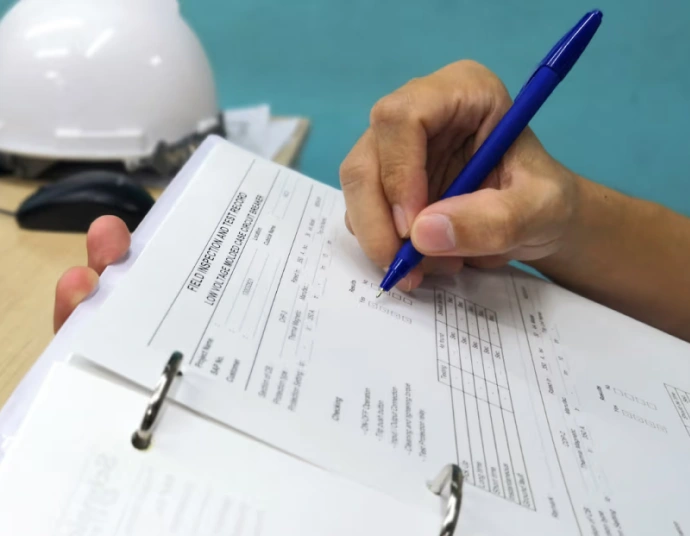
- Startup and handover papers: commissioning checklists and test records; for the formal reporting side, see translating commissioning reports.
- On-product material: the warnings and instruction plates affixed to the equipment; this page covers how we handle label and signage text.
Clients who bundle these documents into one project get a second benefit beyond consistency: shared translation memory across the set reduces the total word count you pay for, often by 20–35 percent on document families with heavy internal repetition.
Timelines, Formats, and How a Project Runs
Installation documentation tends to arrive with a launch date attached, so our process is built for predictable schedules. A representative project: a European manufacturer of commercial refrigeration units entering the US market sent us a 140-page installation and startup manual in German, authored in InDesign, with 60 diagrams. We delivered US English with NEC-aligned electrical terminology, dual Nm/lb-ft torque tables approved by their engineering office, and rebuilt artwork in four weeks, followed a week later by a Spanish edition for their installer network, reusing 40 percent of the layout work.
The workflow follows our ISO 17100-compliant process: specialized translation, full independent review by a second linguist, then numeric and unit verification as a distinct QA pass. As an ATA and GALA member agency, we certify translations when your compliance file requires it. Formats we accept include InDesign, Word, FrameMaker, DWG and DXF for drawings, and PDF-only legacy manuals that we rebuild before translating. Typical turnaround for a 100-page installation manual runs 10–14 business days per language, with parallel languages adding little to the calendar. For everything else the product ships with, our full document library shows what we translate and how the pieces fit together.
Installation Manual Translation: Frequently Asked Questions
Do you convert units when translating an installation manual?
Only when you ask us to, and never inside the translation step itself. Translators pass every numeric value through untouched; unit conversion is a separate operation performed against a conversion table your engineers approve, then verified value by value in a dedicated QA pass. For US-bound manuals we typically add imperial units alongside metric, with the controlling value listed first per your specification. This separation of translation and conversion is how we prevent the classic failures: inverted conversions, over-rounding on low-torque fasteners, and lb-ft printed where lb-in was meant.
Can you translate our electrical schematics and wiring diagrams?
Yes. If the schematics are editable, including native AutoCAD DWG files, we translate the text inside the drawing while preserving layers, blocks, and line work, and deliver files your engineers can keep maintaining. Terminal designations and device tags follow your engineering conventions and are left untranslated where they are identifiers. For flattened or scanned drawings, we create keyed legends matched to the callout numbers. We also review wire color names and electrical vocabulary against the target market's code, NEC for the US, so the diagram reads correctly to a local electrician.
How long does installation manual translation take?
A typical 100-page installation manual takes 10–14 business days per language, including independent review, numeric verification, and layout work. Additional languages run in parallel, so a three-language delivery lands only a few days after a single-language one. Short setup guides of 10–20 pages usually ship in 3–5 business days. If your product launch or trade show imposes a harder date, tell us at quote stage: we can compress schedules by teaming translators on a shared termbase, and we will tell you honestly what is achievable without cutting the verification pass.
What file formats do you accept for drawings and manuals?
For text documents: InDesign, FrameMaker, Word, and structured XML or DITA. For drawings: DWG and DXF natively, plus exports from SolidWorks, Inventor, and Revit; we work inside the CAD file rather than annotating a PDF, so your drawing set stays maintainable. If all you have is a PDF, including scans of older manuals, we rebuild an editable source first and price that step transparently in the quote. Deliverables always include final print-ready PDFs plus the native editable files in the target language.
Does a translated installation manual affect warranty claims?
It affects them in your favor, twice. First, installers who can actually read the manual make fewer mistakes, which reduces improper-installation failures before they become claims. Second, most warranties exclude damage from improper installation, and that exclusion is easier to stand behind when the installer demonstrably had usable instructions in their working language. In disputes, the translated manual becomes evidence, so accuracy matters: we verify torque values, clearances, and mandatory steps individually, and we can provide a signed certification of translation accuracy for your compliance file.
Which languages do manufacturers request for installation manuals?
For products installed inside the US, Spanish leads by a wide margin, reflecting the composition of the installation and construction workforce. Products sold into Canada add Canadian French, which Quebec expects for equipment documentation. Exporters most often request German, French, Spanish, and Italian for the EU, plus Brazilian Portuguese and Latin American Spanish for the Americas. We maintain trade-specific terminology in each: an installation manual needs the vocabulary of electricians and fitters, not general technical language, and our reviewers are chosen accordingly.