
Safety & compliance
Safety Label Translation Services
Techniwords provides safety label translation and signage translation aligned with ANSI Z535, ISO 3864, and OSHA requirements. We render signal words, hazard statements, and avoidance instructions so they warn as forcefully in Spanish or Portuguese as your engineers intended in English.
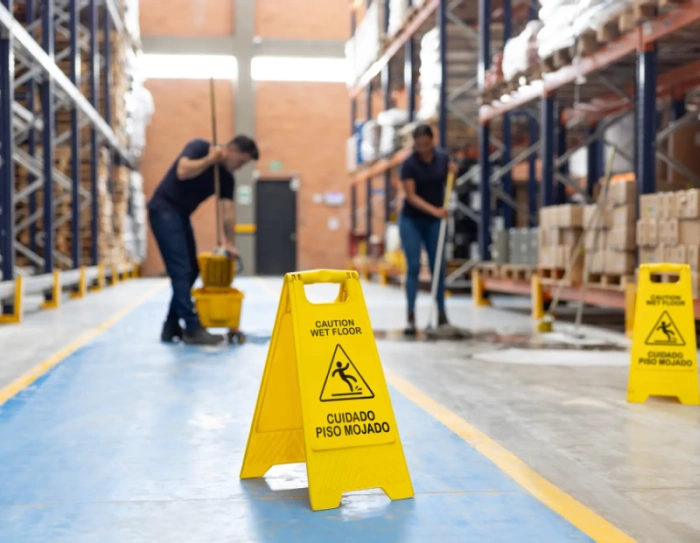
DANGER, WARNING, CAUTION, and NOTICE each map to one fixed equivalent per language, matched to the ANSI Z535 hazard level, never swapped for synonyms.
Failure-to-warn claims turn on whether foreseeable users understood the warning. Our translations are drafted and revised so they can be defended sentence by sentence.
We return labels in Illustrator, EPS, or SVG with layers and dielines intact, sized so the translated text respects Z535.4 letter-height minimums at final print scale.
One Wrong Word on a Warning Label Can End Up in Court
No category of technical text carries more legal weight per word than a warning. A product label has perhaps ten words to identify a hazard, state its consequence, and tell the user how to avoid it. If those ten words fail, the outcome is not a support ticket. It is an injury, an OSHA citation, or a products liability suit in which the label itself becomes Exhibit A. Safety label translation is the discipline of carrying that ten-word burden across languages without dropping any of it.
American courts have examined English-only warnings for decades. As far back as Hubbard-Hall Chemical Co. v. Silverman in 1965, a federal appeals court upheld liability where pesticide labels failed to adequately warn the Spanish-speaking farm workers who foreseeably handled the product. The principle that emerged, and that plaintiff attorneys still argue today, is that the duty to warn runs to foreseeable users, in a form those users can understand. For a manufacturer whose products are installed, operated, and serviced by a workforce where millions speak Spanish first, that principle has a direct translation budget attached.
Techniwords has translated warning content for fifteen years: machine labels, facility signage, lockout placards, and the safety sections that anchor them in manuals. This page covers labels and signs specifically; the wider ecosystem of safety documents is listed in our full document library.
ANSI Z535: The American Grammar of Warnings
In the United States, warning design is standardized by the ANSI Z535 series. Z535.1 fixes the safety color code, Z535.2 governs environmental and facility signs, Z535.4 covers product safety labels, and Z535.6 defines how safety messages appear inside collateral such as manuals. The standards prescribe a structure that translators must respect element by element: a signal word panel, a symbol panel, and a message panel stating the hazard, the consequence of ignoring it, and how to avoid it.
The signal words are the strictest part. DANGER marks a hazard that will cause death or serious injury; WARNING marks one that could; CAUTION signals lesser injury; NOTICE addresses property damage and practices. These are graded legal categories, and each must map to exactly one equivalent per target language, used consistently across every label, sign, and manual you publish. Here is the mapping we apply for Spanish, the most requested language for US safety content:
| Signal word | ANSI Z535 meaning | Spanish equivalent |
|---|---|---|
| DANGER | Will cause death or serious injury | PELIGRO |
| WARNING | Could cause death or serious injury | ADVERTENCIA |
| CAUTION | Could cause minor or moderate injury | PRECAUCIÓN |
| NOTICE | Property damage or non-injury practices | AVISO |
The trap is that everyday Spanish treats several of these as near-synonyms, and a translator without safety training will happily vary them for style. In a Z535 context that variation collapses the hazard grading your engineers assigned. We lock the mapping in the termbase, and our revision step checks every occurrence mechanically before a human reads for meaning.
ANSI or ISO 3864? Usually Both on the Same Label
Products sold internationally meet a second system: ISO 3864, which defines safety colors and sign design globally, and ISO 7010, which standardizes the symbols themselves. ISO's philosophy leans on symbols to cross language barriers; ANSI's leans on words plus symbols. Since the 2011 harmonization of Z535.4, US labels may incorporate ISO-formatted symbol panels, and most multinational manufacturers now run hybrid labels: ISO symbol, ANSI signal word, message panel in one or more languages.
For translation, the hybrid format is good news with one catch. Symbols carry part of the meaning, so the text can stay short, but the text that remains must not contradict or duplicate the symbol clumsily. When we translate a label set, we review each message against its assigned ISO 7010 referent, and we flag labels where the source English already drifted from the symbol, which happens more often than manufacturers expect. Fixing that drift in English before translating it into four languages is cheaper than discovering it during a safety audit.
OSHA's General Duty Clause does not care what language your workforce speaks; it cares what they understood. OSHA 29 CFR 1910.145 specifies when accident prevention signs and tags are required, and OSHA compliance directives instruct inspectors to verify that safety information reaches employees in a language and vocabulary they comprehend. An English-only DANGER tag in a crew that reads Spanish is, functionally, an unmarked hazard.
Multilingual Job Sites Are the American Normal
The question is no longer whether US facilities need multilingual signage. Roughly one in three construction workers in the United States is Hispanic or Latino, and on many Texas, Florida, and California sites Spanish is the majority language of the crew. Manufacturing plants add Vietnamese, Haitian Creole, and Portuguese to the mix depending on region. Facility signage, confined space permits, and lockout points all speak to that workforce, or fail to.
We support general contractors and plant operators with bilingual and trilingual sign programs: entrance signage, crane and excavation warnings, PPE requirement boards, and temporary signage for shutdowns and turnarounds. For contractors, this work usually arrives through our broader construction translation engagements; for plant operators, it often starts when an insurer or corporate EHS audit flags English-only signage, and you can learn more here about how we support manufacturing sites. Signage also never stands alone: the same hazards appear in job safety analyses, and we translate those with matching vocabulary as part of our risk assessment translation work, so the sign on the machine and the JSA in the binder never disagree about what the hazard is called.
Tags, Placards, and Temporary Warnings Count Too
Permanent signs get the budget and the attention, but OSHA 1910.145 covers accident prevention tags as well, and tags are where multilingual practice most often breaks down. A DANGER tag hung on a breaker during maintenance, a "Do Not Operate" placard on a valve, a confined space entry permit posted at a manhole: these are produced in small batches, ordered from whoever delivers fastest, and frequently exist only in English even at facilities that invested in bilingual permanent signage.
The inconsistency is not cosmetic. A lockout tag is the last line of communication between the technician who isolated the energy source and anyone who might restore it, and the person walking past the tagged breaker may be a contractor's crew member who reads only Spanish. Facilities that translate their permanent signs but leave tags in English have translated the warnings people see daily and skipped the ones that mark active, immediate hazards.
We translate tag and placard programs as standardized sets: the facility's stock of lockout tags, out-of-service placards, hot work and confined space permit forms, and the temporary signage used during shutdowns and turnarounds. Because tags are reprinted constantly, we deliver the translations as locked templates in your print vendor's format, so every reorder reproduces the approved wording instead of inviting a well-meaning supervisor to retranslate a tag with an online tool the night before an outage. Several clients adopted this after near-miss investigations traced confusion to improvised translations on temporary tags.
Extreme Concision: Warning in Forty Characters
A Z535.4 label gives the message panel a few square inches, and letter height minimums scale with viewing distance, so the space cannot be bought back by shrinking type. Spanish and French run 15 to 25 percent longer than English. Something has to absorb that expansion, and it cannot be the meaning.
Warning translation is therefore an exercise in disciplined compression. Our translators work with the hazard-consequence-avoidance structure explicitly, so every character spent must serve one of the three. Articles get dropped where target-language convention allows, verb forms are chosen for brevity, and standard telegraphic constructions replace full sentences, the same way English warnings say "Keep hands clear" rather than "You should keep your hands clear." What never gets compressed away: the consequence. "Moving parts" is a description; "Moving parts can crush hands" is a warning. We defend that distinction in every language, at any character count.
An example from a recent project: a machine builder shipping packaging lines to plants in Texas and Puerto Rico sent us their 214-label set for Spanish. Their previous vendor had translated fluently but 30 percent long, and the panels were unusable at the mandated letter heights. We retranslated to fixed character budgets per label, kept the signal word mapping intact, and delivered Illustrator files with both languages laid out to Z535.4 geometry. Their EHS manager signed off after spot-checking against the standard, and the label set passed the customer's third-party safety audit without a single language finding.
Labels Never Stand Alone: Consistency With Manuals and Procedures
Z535.6 exists because warnings live inside documents too, and the law treats the labeling system as a whole. A plaintiff's expert will read your on-product label against section 2 of your manual, and any contradiction between them becomes an argument that the warning system was defective. The same coupling exists on the shop floor between machine placards and the step-by-step procedures posted beside them.
We manage this by translating warning content as a system, not as scattered strings. The hazard statements on your labels are stored as locked segments, and when we handle translating operating instructions or embedded safety sections for the same machine, those exact segments are reused verbatim. The approach carries through consumer documentation as well; the safety messages we translate for equipment labels reappear identically in the owner documentation covered on this page. Chemical hazards add one more layer: label wording must track the product's hazard communication documents, so we coordinate directly with our safety data sheet translation team when a label set involves GHS-classified substances.
How We Deliver: Vector Files, Verified Geometry, Documented Choices
Safety labels are artwork, and we deliver them as artwork. Our process, aligned with ISO 17100 and refined through our membership in ATA and GALA, runs as follows:
- Inventory and classification. Every label and sign is cataloged with its Z535 or ISO format, hazard level, viewing distance, and available message panel space per language.
- Terminology lock. Signal word mappings and recurring hazard phrases are fixed and sent for your EHS team's approval before translation.
- Translation to character budgets. Certified translators with safety documentation experience write inside the measured space for each panel.
- Independent revision. A second linguist verifies hazard, consequence, and avoidance are all present and that no signal word drifted from its mapping.
- Artwork production and proof. Labels are rebuilt in Illustrator, EPS, or SVG with layers intact, then proofed at print scale against letter-height minimums.
Every non-obvious choice is recorded in a decision log delivered with the files. If a regulator, auditor, or opposing counsel ever asks why a particular Spanish phrasing was chosen, you will have a documented answer written at translation time, from our Texas office, by a named professional team, not a reconstruction attempted years later.
Safety Label Translation: What Clients Ask Us
What are the correct Spanish equivalents of DANGER, WARNING, and CAUTION?
The mappings used consistently in US safety practice are PELIGRO for DANGER, ADVERTENCIA for WARNING, PRECAUCIÓN for CAUTION, and AVISO for NOTICE. What matters as much as the words is their exclusivity: each English signal word maps to exactly one Spanish term, applied identically across every label, sign, and manual, because the signal word encodes the ANSI Z535 hazard severity grade. Everyday Spanish treats several of these terms as interchangeable, which is precisely why safety translation cannot be handled as everyday Spanish.
Does US law require safety labels in languages other than English?
No federal statute imposes a blanket requirement, but two forces push the same direction. OSHA expects safety information and training to be delivered in a language and vocabulary employees understand, and inspectors verify this. In products liability, courts have found manufacturers liable under failure-to-warn theories when foreseeable users could not read English-only warnings, a line of cases running back to the 1960s. For products or facilities with a known Spanish-speaking user base, English-only warnings are a documented, avoidable legal exposure.
Can you work directly in our vector label artwork?
Yes. We take Illustrator, EPS, SVG, and CorelDRAW files and return them with translated text placed, layers and dielines preserved, and fonts either licensed equivalents or outlined per your printer's preference. Text is fitted to the message panel at final print scale, checked against the letter-height minimums for the label's viewing distance. If your artwork exists only as flattened PDFs or photographs of installed signage, we rebuild vector masters first, which we quote separately and you keep.
How do you keep label warnings consistent with our manuals?
Warning statements are translated once and stored as locked segments in your termbase. When we later translate the manual, the safety section reuses those exact segments verbatim rather than retranslating them, which is the approach ANSI Z535.6 implies and product liability defense favors: one hazard, one wording, everywhere. If your manuals were translated earlier by another vendor, we extract their warning language first and either adopt it or propose corrections in writing for your approval, so the change is deliberate and documented.
Can translated labels be checked before a customer safety audit?
Yes, and it is a common engagement. We review installed or planned signage and label sets against ANSI Z535, ISO 7010 symbol usage, and OSHA 1910.145 categories, in English and in the translated languages, then report mistranslated signal words, missing consequence statements, text below letter-height minimums, and inconsistencies with your written procedures. Clients typically run this three to six weeks before an insurer, corporate EHS, or customer audit, which leaves time to reprint the labels that need it.
Which languages do US clients order most for safety labels?
Spanish leads by a wide margin, reflecting workforce demographics in construction, manufacturing, and food processing. Portuguese, Vietnamese, Haitian Creole, and Chinese follow, varying strongly by region and industry. Export manufacturers add Canadian French for USMCA shipments and the EU languages their machines ship into. We help clients prioritize using their own workforce and market data: the legally relevant question is which languages your foreseeable users actually read, not which languages are cheapest to add to the artwork.