Automation expertise
Robotics Translation Services for Integrators and Plants
Techniwords provides robotics translation services covering controller manuals, cell risk assessments, HMI strings, and operator training for automation projects across the United States. Our specialists move Fanuc, Yaskawa, Siemens, and Doosan documentation between Japanese, German, Korean, and English without losing a single parameter name.
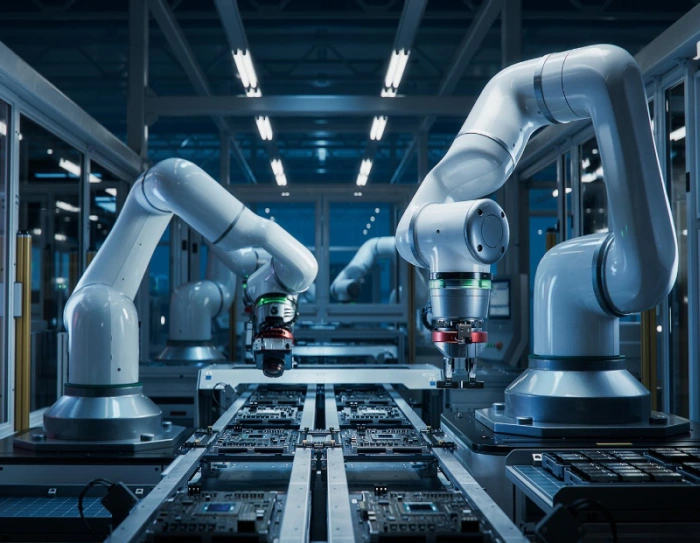
Our linguists work daily with Fanuc, Yaskawa, KUKA, ABB, and Siemens source material and keep the vocabulary of each platform intact, from teach pendant menus to alarm code tables.
We translate cell risk assessments using the exact safety terms of ANSI/RIA R15.06 and ISO 10218, so your compliance file reads the way an OSHA inspector or safety engineer expects.
We translate inside exported string tables from TIA Portal, FactoryTalk, and robot controllers, respecting character limits and variables so screens display correctly on the first import.
Robotics translation services built for the American factory floor
The Association for Advancing Automation counts roughly 30,000 industrial robots installed in North America in a typical recent year, and the overwhelming majority of those machines were engineered somewhere else. Fanuc, Yaskawa, Kawasaki, and Denso write their source documentation in Japanese. KUKA, Siemens, Festo, and Beckhoff write theirs in German. Doosan Robotics and Hyundai Robotics publish first in Korean. The plant in Ohio or Tennessee that buys the cell, meanwhile, needs operator instructions its workforce can actually follow, and its integrator needs safety files that satisfy American standards.
That gap between where robots are designed and where they run is the entire reason this practice area exists at Techniwords. For 15 years we have translated automation documentation in both directions: inbound manuals and engineering files for US plants installing foreign-built robots, and outbound proposals, training packages, and interface text for American integrators selling cells abroad. The work sits at the intersection of mechanical engineering, controls programming, and machine safety, and we staff it with translators who have lived in that intersection, not generalists with a dictionary.
A robot is never just a robot, either. It arrives with a controller cabinet, a teach pendant, end-of-arm tooling, safety scanners, a fence or a force-limiting design, conveyors, and a PLC that supervises everything. Each element brings its own documentation, often from a different manufacturer in a different country. Assembling that pile into one coherent, bilingual documentation set is the job we do most often.
What an automation project generates on paper
By the time a cell is commissioned, an integrator has produced or received hundreds of documents. These are the ones that cross our desks most frequently:
- Cell risk assessments and hazard analyses. Task-based assessments scored by severity, exposure, and avoidance, usually following RIA TR R15.306 methodology. Our risk assessment translation work keeps the scoring vocabulary consistent from the original document to the US compliance file.
- Operating instructions for production staff. Start-up, mode selection, fault recovery, and shutdown sequences written for the person standing at the cell gate. We translate operating instructions so a second-shift operator can recover from a fault without calling engineering.
- Robot and PLC software documentation. Program structure descriptions, I/O maps, alarm lists, and commented code. See our software documentation translation services for how we handle commented ladder logic and structured text.
- Installation and integration guides. Foundation drawings, dress pack routing, cable schedules, and commissioning checklists from the robot OEM.
- Training curricula. Slide decks, exercises, and certification tests for operators and maintenance techs.
Most projects need several of these at once, on a schedule dictated by the commissioning plan rather than by translation convenience. We build our delivery calendar around your runoff dates, not the other way around.
ANSI/RIA R15.06 and the risk assessment you cannot skip
The governing safety standard for industrial robots in the United States is ANSI/RIA R15.06, which adopted ISO 10218-1 and ISO 10218-2 as its technical core. The 2012 edition made one requirement unmistakable: every robot system must have a documented, task-based risk assessment before it goes into service. There is no exemption for small cells and none for used equipment moved from another site.
Here is where language enters the picture. When a US manufacturer buys a cell from a German integrator or receives a hazard analysis prepared by a Japanese OEM, that assessment arrives in the source language, structured around EN ISO 12100 conventions. The severity classes, the exposure frequencies, the risk reduction hierarchy: all of it must land in English with the exact terms American safety engineers use, because the translated assessment becomes part of the employer's compliance record. If a "protective stop" gets rendered as an "emergency stop," the document now describes a different safety function with different circuit requirements, and an auditor will notice.
Our translators work from the published English editions of ISO 10218 and R15.06 as their terminology reference, so functional safety concepts such as safety-rated monitored stop, speed and separation monitoring, and hand guiding appear in your file precisely as the standards write them. When the source document cites a European norm with no US twin, we keep the citation and add a translator's note rather than inventing an equivalence that does not exist.
One requirement, zero flexibility: ANSI/RIA R15.06-2012 requires a documented risk assessment for every robot system installed in the US, including relocated and rebuilt cells. A hazard analysis your plant cannot read in English does not satisfy that requirement, no matter how thorough the original was.
HMI screens, PLC comments, and teach pendant text
Interface translation is where robotics projects most often go wrong, because the text does not live in a document. It lives in string tables inside TIA Portal, FactoryTalk View, or the robot controller itself, and every field has a character budget. A Japanese alarm message that fits in ten characters can need forty in English. Translate it in a spreadsheet without the limits visible and the operator will see "CONVEYOR JAM AT STA" with the station number cut off.
We handle interface work in the native export formats: XLIFF or Excel exports from TIA Portal, CSV dumps from FactoryTalk, and the vendor-specific formats Fanuc and Yaskawa use for pendant customization. The linguist sees the character limit next to each string, proposes approved abbreviations where the budget is tight, and flags anything that genuinely cannot fit for engineering review. Placeholders and variables such as %d or tag references pass through untouched, and we verify every file re-imports before delivery. The same discipline applies when translating installation guides that reference screen names: the manual must call a screen exactly what the HMI calls it, in both languages, or the manual is useless.
PLC comments deserve a mention of their own. When a US plant inherits a line programmed in German, the rungs still execute, but nobody in maintenance can read why. Translating the comment fields and symbol tables turns an opaque program back into a maintainable one, and it costs a small fraction of reprogramming.
Japanese, German, and Korean: where robot documentation originates
Three language pairs dominate our robotics work, and each behaves differently.
Japanese is the largest by volume. Fanuc alone has an installed base in North America measured in the hundreds of thousands of units, and its deepest technical material, especially older maintenance manuals and engineering change notices, exists only in Japanese. Our Japanese technical translation team includes former controls engineers who recognize when a source sentence describes a servo parameter rather than a mechanical adjustment, a distinction Japanese grammar does not always make obvious.
German covers KUKA robots, Siemens automation, and the dense ecosystem of European component makers: Festo pneumatics, SICK safety scanners, Pilz relays, Beckhoff controllers. German source text tends to be precise but heavily nominalized, and a literal rendering reads like legal prose. Our German linguists produce English that an American maintenance tech will actually read. You can learn more here about how that team works.
Korean is the growth pair. Doosan Robotics and Hyundai Robotics are pushing hard into the US cobot and heavy-payload markets, and their integrator documentation frequently arrives in Korean first with English editions lagging months behind. We close that gap for distributors who cannot wait for the official translation.
Terminology that trips up general translators
Robotics vocabulary punishes approximation. These are real examples from our review logs, the kind of errors we catch when auditing translations done elsewhere:
| Term | Why it goes wrong | What is at stake |
|---|---|---|
| Protective stop vs. emergency stop | Casual translators treat them as synonyms; ISO 10218 defines them as distinct functions with different reset behavior | Safety circuit design and validation records |
| Collaborative operation | Often rendered as "cooperation" or "co-working," which erases the four defined ISO/TS 15066 methods | Whether a fence is legally required |
| Singularity | Translated literally as "uniqueness" from Japanese in one manual we corrected | Operators cannot diagnose why the arm faults mid-path |
| Payload vs. handling capacity | Japanese sources use one word for both rated and maximum values | Tool selection and warranty claims |
| Mastering / zeroing / calibration | Each OEM uses a different term for axis reference; mixing them confuses cross-trained techs | Position accuracy after battery replacement |
Every robotics client gets a project glossary built during the first job and enforced on every job after it. When your OEM says "mastering" and your PLC vendor says "homing," the glossary records both, notes which machine each applies to, and keeps your documentation from silently swapping them.
Cobots change the documentation stakes
Collaborative robots are the fastest-growing slice of the market, and they carry a documentation trap. Because a cobot can run without a fence under specific conditions, the documents defining those conditions do the safety work a fence would otherwise do. ISO/TS 15066 sets biomechanical force and pressure limits for each body region, and the application documentation must show the measured values against those limits.
Marketing language makes this harder. Vendor brochures say "inherently safe" and "works alongside people out of the box." The technical file says power and force limiting applies only to the validated application, with the validated tooling, at the validated speeds. When we translate cobot documentation, we keep those two registers strictly apart: promotional copy can be persuasive, but the risk assessment, the force measurement report, and the operator instructions get the conservative, standard-referenced wording that protects the deployer. A Texas-based reviewer, independent from the original translator, checks every safety-relevant sentence against the source under our ISO 17100-compliant process before anything ships.
Training the people who stand next to the robot
Automation does not remove people from production; it changes what they do. Someone still loads blanks, clears jams, swaps grippers, and verifies mastering after a crash. OSHA expects that training reaches workers in a form they understand, and in plants with large Spanish-speaking crews that regularly means bilingual delivery. We prepare operator and technician curricula in English-Spanish pairs alongside the primary engineering languages, and our work on training materials covers slides, hands-on exercise sheets, and the written tests that document competency.
One project illustrates the shape of this work. An integrator commissioning a 14-robot welding line in Kentucky came to us eight weeks before runoff with a mixed package: Japanese robot manuals, German safety scanner documentation, and an in-house training deck that had to reach a workforce split between English and Spanish. We staged deliveries chapter by chapter against their commissioning plan, built a four-language glossary in the first ten days, and had validated pendant strings loaded before the customer's acceptance test. The line passed runoff on schedule, and the plant's safety manager filed a risk assessment his own team could read.
How we run a robotics project
Techniwords has spent 15 years on industrial documentation, and robotics projects follow a process shaped by that experience. A project engineer inventories your files and separates what needs full translation from what needs extraction (drawings with embedded text, string tables, PDF scans of legacy manuals). Specialized translators work with the project glossary from day one. An independent reviser compares every segment against the source, which is standard practice for us as an ATA and GALA member firm, not an optional extra. Delivery arrives in your original formats, whether that is InDesign manuals, Excel string tables, or commented source code, ready to hand to your customer or load into the controller.
Robotics work also connects naturally to the rest of a plant's documentation. Many of our automation clients started with a single cell manual and now route their entire manufacturing documentation through the same team, because the glossary and the institutional memory compound with every project.
Robotics translation questions we hear most
Can you translate Fanuc, Yaskawa, or Siemens controller documentation?
Yes. Our Japanese team works with Fanuc and Yaskawa Motoman source material every week, and our German linguists cover Siemens, KUKA, and Beckhoff documentation. We maintain a glossary for each controller family, so terms like teach pendant, DCS, and safety-rated monitored stop stay consistent with the vocabulary your technicians already see in the original interface. If you only have PDFs, we rebuild the layout. If you have source files, we work directly in them and deliver ready-to-publish documents.
Do you translate robot cell risk assessments under ANSI/RIA R15.06?
We do, and they are one of our highest-volume robotics documents. R15.06 requires a documented, task-based risk assessment for every robot system, and many integrators receive hazard analyses from European or Japanese partners that must become usable compliance records in English. We translate the full package: hazard identification tables, severity and exposure scoring, risk reduction measures, and validation checklists, keeping the vocabulary aligned with RIA TR R15.306 so nothing shifts in meaning between the original assessment and your file.
How do you handle HMI translation when screens have character limits?
We translate directly in exported string tables from TIA Portal, FactoryTalk, or your SCADA package, with the character limit for each field visible to the linguist. Where a Japanese message fits in ten characters but English needs forty, we propose approved abbreviations and flag every truncation risk in a review file before delivery. Variables and tag references pass through untouched. You get strings that import back cleanly, plus a short report listing any field that needs an engineering decision.
Can you take on the full documentation set for an integrated cell?
That is the typical engagement. A cell arrives with robot manuals from one OEM, safety component documentation from two or three others, a PLC program with foreign-language comments, and an integrator's own operating and maintenance instructions. We assign one team and one glossary to the whole set, then stage deliveries against your commissioning calendar so operator instructions and pendant strings arrive before runoff and archival material follows. One point of contact manages the entire package.
Is cobot documentation different from standard robot documentation?
Yes, in one important way: when a collaborative application runs without a fence, the documentation itself carries safety weight. ISO/TS 15066 sets force and pressure limits by body region, and the application file must show measured values against those limits. We keep marketing language and safety language strictly separate, translate force measurement reports and risk assessments with standard-referenced wording, and never let a phrase like "inherently safe" migrate from a brochure into a technical file.
How fast can you deliver a translated robot manual?
A 300-page maintenance manual from Japanese to English typically takes 3–4 weeks including independent revision and desktop publishing. When commissioning dates are tight, we deliver chapter by chapter in the order your team needs them, usually starting with safety sections and fault recovery. For urgent single documents, such as an alarm list needed before a weekend install, we can often turn work around in 24–48 hours. Send the files and we will quote a real date, not a range.
Commissioning date coming up? Get the documentation ready first.
Send us your robot manuals, risk assessments, or HMI exports and we will return an itemized quote with a delivery schedule built around your runoff date. Fanuc, KUKA, Siemens, Yaskawa, Doosan: we already speak your controller's language.
Get a Free Quote