Defense & Security
Defense Translation Services
Techniwords translates proposals, maintenance manuals, and training packages for contractors that sell to the US government and its allies. Controlled technical data stays with vetted US person linguists working inside a restricted, US-based environment.
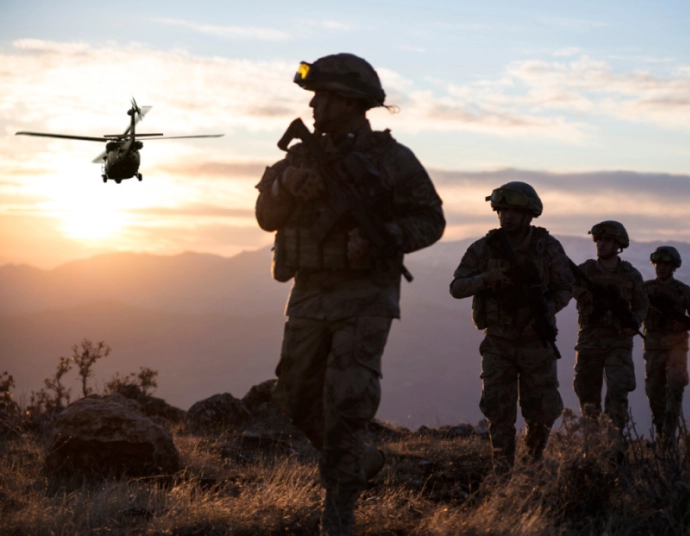
Every ITAR-controlled file is assigned to US citizen or lawful permanent resident linguists working on US-hosted infrastructure. No offshore vendors, no foreign cloud storage.
We have delivered operator manuals, depot documentation, and courseware for Foreign Military Sales cases in Korean, Japanese, German, and French.
RFP responses run on unforgiving clocks. We stage certified translators in shifts so a 200-page volume moves through translation and independent revision in days.
Translation Support for the Defense Industrial Base
American defense exports are running at historic levels. Foreign Military Sales set back-to-back records in fiscal years 2023 and 2024, with the 2024 total exceeding 100 billion dollars, and Direct Commercial Sales added a comparable volume on top. Every one of those transactions generates paperwork that has to cross a language barrier: proposals evaluated by foreign ministries of defense, operator manuals read by allied crews, training curricula taught at partner academies, and sustainment documentation used in depots from Seoul to Stuttgart. Defense translation services exist to move that material accurately without ever compromising the export controls attached to it.
The work reaches far beyond the prime contractors. A tier-two machine shop in Ohio that supplies a turret component may receive a Korean-language quality escape report from an FMS customer. A simulation company in Orlando may need its instructor guides in French for a NATO training center. Because export control obligations flow down through the supply chain by contract, the translation vendor those companies choose becomes part of their compliance posture. Techniwords has spent 15 years building a workflow that holds up under that scrutiny, from our base in Texas, with certified translators who work on defense material and nothing but comparable technical content.
ITAR and EAR: The Export Rules That Follow Every Document
The International Traffic in Arms Regulations, 22 CFR Parts 120-130, control defense articles on the United States Munitions List and, just as importantly, the technical data that describes them. Under 22 CFR 120.33, technical data includes the information required for the design, manufacture, operation, maintenance, or modification of a defense article. That definition captures most of what a translator touches on a defense program: drawings, specifications, repair procedures, software documentation, test reports.
A translation is an export. Under 22 CFR 120.50, releasing controlled technical data to a foreign person is an export even if the file never leaves the United States. Handing a manual to a translation agency that uses foreign nationals, or a server abroad, can be an unauthorized transfer. Choosing a translation vendor is an export control decision.
Items that have migrated to the Commerce Department side under Export Control Reform carry 600-series ECCNs under the Export Administration Regulations, with their own license conditions. The distinction matters for authorizations, but for translation workflow purposes we treat both regimes with the same discipline: US person linguists, US-based processing, and access limited to the named project team. Civil penalties for ITAR violations now exceed one million dollars per violation, and voluntary disclosures regularly cite uncontrolled vendor transfers as the root cause. Our job is to make sure translation never appears in that paragraph of anyone's disclosure.
CUI and DFARS 252.204-7012: Where Your Files Live Matters
Most defense documents we translate are not classified, but a large share carry Controlled Unclassified Information markings. Contractors bound by DFARS 252.204-7012 must protect covered defense information in line with NIST SP 800-171 and report cyber incidents within 72 hours. When CUI flows to a subcontractor or a service provider, the safeguarding obligation travels with it. We built our handling procedures around that reality: encrypted transfer and storage, role-based access limited to the assigned linguists, activity logging, and deletion certificates at project close when the contract requires them.
Formatting is part of compliance too. CUI banner markings, portion markings, distribution statements, and destruction notices must survive the journey into the target language, in the right position on every page. Our project managers reproduce distribution statements verbatim where regulations require English retention and translate them where the receiving government expects a localized equivalent, following the direction of your export compliance officer. With CMMC assessments now phasing into DoD contracts, several clients have asked us to complete supplier questionnaires on our handling controls; we answer them directly and quickly.
Teaming Agreements, Offsets, and Incoming Foreign Documentation
Translation on defense programs runs in both directions. Before a single deliverable leaves the United States, American contractors receive a stream of foreign-language material that shapes their bids: national procurement regulations, partner specifications written to European norms, evaluation criteria published by a ministry of defense, and industrial cooperation requirements. Many allied governments condition major purchases on offset obligations, local production, technology transfer, or in-country sustainment, and those obligations arrive as dense legal-technical documents in Korean, German, or French. We translate them into precise American English so contracts teams and offset managers know exactly what they are signing up to deliver over the next decade.
Export authorizations generate their own paperwork. Technical Assistance Agreements and Manufacturing License Agreements under ITAR Part 124 must describe the data being transferred, and when a foreign partner drafts its inputs in its own language, someone has to render them faithfully for the empowered official who signs the application. The same goes for end-use statements, foreign quality clauses, and supplier flow-downs coming back from overseas licensees. A mistranslated scope line in an agreement can either strand a program waiting for an amendment or, worse, authorize less than the team believes it did. Our linguists work alongside export compliance staff on these documents and flag every passage where the source is ambiguous rather than guessing silently.
There is also the daily traffic of program execution: foreign audit findings, corrective action requests from an allied quality authority, meeting minutes from a joint program office, and correspondence with in-country agents. None of it is glamorous, and all of it stalls a program when it sits untranslated in an inbox. We keep a standing team briefed on each active account so a six-page letter from a partner nation turns around in 24 hours instead of waiting for a new vendor onboarding cycle.
The Defense Documents We Translate Most
Proposal season drives the sharpest deadlines. When an allied ministry issues a solicitation in its own language, we translate the incoming requirements so capture teams can bid with confidence, then render the response volumes back into the customer's language. Our technical proposal translation work covers executive summaries, technical volumes, management volumes, and compliance matrices, and we support the intake side by translating RFP and tender packages issued by foreign procurement agencies.
Sustainment produces the volume. A single vehicle or radar program can require thousands of pages of field and depot maintenance manuals, illustrated parts breakdowns, and troubleshooting trees, all of which must match the source step for step. Training commands add courseware and training materials: lesson plans, instructor guides, simulator scripts, and evaluation rubrics. Drawing packages round out the set; the conventions that govern title blocks, revision tables, and notes are covered on this page. We also handle interactive electronic technical manuals authored in S1000D, translating data modules while preserving their codes and applicability rules.
Foreign Military Sales: Documentation Allied Forces Can Use
FMS cases managed through the Defense Security Cooperation Agency define deliverables in the Letter of Offer and Acceptance, and documentation line items are easy to underestimate at case writing. English-only manuals are acceptable on paper for many partners, yet programs consistently find that maintenance quality and training throughput improve when crews read procedures in their own language. That is why case managers add translated technical manuals, and why we see the same pattern of languages again and again.
| FMS document set | What it contains | Frequent target languages |
|---|---|---|
| Operator and crew manuals | Controls, operating limits, emergency procedures, preventive checks | Korean, Japanese |
| Depot and intermediate maintenance data | Disassembly sequences, tolerances, special tools, torque values | German, French |
| Training curricula | Programs of instruction, lesson plans, student handouts, exams | Korean, French |
| Provisioning and parts documentation | Illustrated parts breakdowns, NSN cross-references, packaging data | Japanese, German |
Northeast Asian allies generate steady demand: our Korean technical translation team supports programs headed to the Republic of Korea, and Japanese work follows a similar rhythm for maritime and rotary-wing platforms. European cases lean on German and on French, the latter doubling as a NATO working language. Where a partner requires certified translations for acceptance, we provide signed certificates of accuracy with each delivery.
NATO STANAGs and Coalition Terminology
Interoperability documents bring their own vocabulary. NATO standardization agreements, the STANAGs, define everything from UAV control interfaces under STANAG 4586 to ammunition interchangeability, and the alliance maintains its official terminology in AAP-06, the NATO Glossary of Terms and Definitions, published in both English and French. When we translate coalition-facing material into French for NATO programs, we align with AAP-06 equivalents rather than inventing parallel terms, because a French officer reading "soutien logistique" expects the glossary meaning, not a translator's improvisation.
The same discipline applies to abbreviations. AAP-15 governs NATO abbreviations, and national forces layer their own on top. Our defense glossaries record the approved expansion and translation for each program, so LRU, TM, and IETM never drift between deliveries. On multinational efforts where a US prime teams with European partners, we frequently maintain a single trilingual termbase that both engineering offices reference during design reviews.
Military Language Is a Language of Its Own
Defense documentation obeys writing standards that shape translation choices. Technical manuals prepared to MIL-STD-38784 follow strict conventions for warnings, cautions, and notes, each with a defined severity that must keep its legal force in the target language. Work packages built to MIL-STD-40051 sequence tasks in a fixed grammar of commands. A translator who renders "shall" as a polite suggestion has changed the contract; ours are trained to preserve the mandatory, conditional, and informative registers exactly.
Nomenclature is the other trap. Official item names, "Truck, Utility: 1-1/4 Ton, 4x4," follow inverted conventions that must be handled consistently, and weapon system designators, AN/SPY-1 or M1A2 SEPv3, are never translated. Calibers, NATO stock numbers, and drawing references stay untouched while surrounding prose changes language. Because we also serve adjacent sectors, our team brings habits from aerospace translation work, where AS9100 traceability and configuration control impose the same rigor on every revision.
A Secure Process, Proven on Real Programs
Our workflow follows ISO 17100: a qualified subject-matter translator, then a full independent revision by a second linguist, both US persons for controlled work, both under program-specific NDAs that name the data they may access. Files stay on access-controlled US servers from receipt to delivery. We are members of the American Translators Association and GALA, and we document linguist qualifications so your compliance office can audit the chain if asked.
A recent example shows the shape of this work. A prime contractor asked us to turn a 1,400-page set of wheeled-vehicle maintenance manuals into French for a European ally, with CUI portion markings preserved page by page and a delivery date tied to the vehicle handover ceremony. Three vetted linguists and one reviser worked from a locked project glossary; delivery landed in nine weeks with a 600-term French termbase the customer now applies across its fleet documentation. No file left US soil at any point, and the client's empowered official signed off on the arrangement before the first page moved.
Deadlines get the same respect as security. Proposal volumes are quoted with day-by-day delivery schedules, and for surge periods we brief backup linguists into the program in advance so capacity never depends on one person. If you are comparing vendors across several sectors, our industry pages show how the same controls adapt to each regulated market.
Defense Translation Questions, Answered
Do you use only US person linguists for defense work?
Yes. Any project involving ITAR technical data or export-controlled content is staffed exclusively with US citizens or lawful permanent residents, verified before assignment. This applies to the translator, the independent reviser, and the project manager who touches the files. For unrestricted marketing or corporate content, we can widen the pool if you prefer, but the default for anything defense-related is US persons only, and we confirm the staffing plan in writing before work begins.
What does your secure processing environment look like?
Controlled files are exchanged through encrypted transfer, stored on access-controlled servers located in the United States, and opened only by the named project team. We disable machine translation and any cloud tool that would route text through external servers. Access is logged, and at project close we can purge all copies and issue a destruction certificate. If your contract imposes NIST SP 800-171 flow-downs under DFARS 252.204-7012, we will complete your supplier security questionnaire and align our handling with your CUI program.
Do your translators hold security clearances?
We do not process classified material, so clearances are not the operative control. The defense documents that reach a translation vendor are almost always unclassified but export-controlled or marked CUI, and the applicable safeguards are ITAR US person requirements and NIST SP 800-171 handling, both of which we meet. If a program involves classified content, translation is normally performed inside the contractor's cleared facility; several clients have engaged our linguists under escort arrangements defined by their facility security officer.
Can you support Foreign Military Sales documentation packages?
Yes. We translate operator manuals, maintenance data, illustrated parts breakdowns, and training curricula for FMS cases, most often into Korean, Japanese, German, and French. We work from the documentation line items in your Letter of Offer and Acceptance, build a program glossary approved by your engineering team, and hold it stable across every delivery so year-three revisions match year-one manuals. Certificates of accuracy are included when the receiving government requires them for acceptance.
How fast can you turn a proposal volume?
A 150 to 200 page technical volume typically moves through translation and full independent revision in five to eight business days, faster if we split it across a briefed team with a shared termbase. The key is early warning: send us the draft outline and compliance matrix while writing is still underway, and we translate rolling sections as they freeze. We quote day-by-day schedules so your capture manager can see exactly what lands when.
How do you keep terminology consistent across a multi-year program?
Every defense program gets a dedicated termbase and translation memory, locked to the platform and customer. Approved nomenclature, abbreviation expansions from AAP-15 or your program dictionary, and customer-preferred renderings are recorded at the first delivery and enforced automatically afterward. When engineering changes introduce new terms, we flag them for your review before use. The result is that a technician comparing a 2022 manual with its 2026 revision sees identical language for identical parts.
Move Controlled Documents Without Export Risk
Send a redacted sample or a page count and language pair, and we will return an itemized quote with a staffing plan naming US person linguists. NDAs are signed before any controlled file changes hands, and your compliance office is welcome to review our handling procedures first.
Get a Free Quote