
Product documentation
Technical Datasheet Translation Services
We translate technical datasheets for electronic components, chemical products, and industrial equipment with the parameter tables, test conditions, and tolerances your customers will hold you to. Values stay untouched, wording stays exact, and the dense two-column layout survives the trip into the new language.
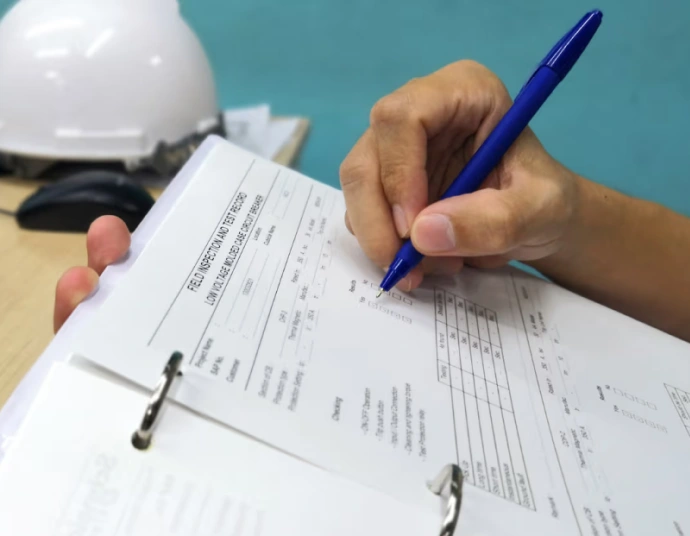
Parameter tables and their test conditions are translated by people who know why "at 25 °C, VCC = 5 V" cannot drift a single word. Numbers are locked, never retyped.
Chemical technical data sheets get performance-property terminology; safety data sheets get codified GHS phrasing. Different documents, different specialists, no cross-contamination.
Two-column spec grids, footnoted tables, and characteristic curves are rebuilt in InDesign or your source format so the German version paginates like the English original.
A Datasheet Is a Commitment, Not a Brochure
Technical datasheet translation carries a weight that marketing localization never does: in industrial purchasing, the datasheet is routinely incorporated into the contract. When a buyer's engineer selects your connector because the sheet promises a contact resistance of 20 mΩ max after 500 mating cycles, that line becomes part of what you sold. If the translated sheet softens "max" into something a court or a sourcing manager reads as "typical", you have changed your legal exposure with one word.
We translate datasheets with that contractual reading in mind. Modal language is mapped deliberately: guaranteed limits keep their hard edges, typical values keep their hedges, and footnotes that condition a specification ("parameter not tested in production, guaranteed by design") are rendered with the same evidentiary force in the target language. Our reviewers read the translation the way an incoming-inspection engineer at your customer would, asking of each line: what could I now claim against this?
The discipline extends to what we refuse to do. We do not convert values, restate tolerances, or "helpfully" round. A sheet that says 0.157 in (4.0 mm) leaves our hands saying exactly that in Korean or German, because the dual dimension is part of the specification. Where a datasheet inherits requirements from a governing document, we align terminology with the related product specification translation so the two documents cannot be played against each other in a dispute.
Electronics Datasheets: Min, Typ, Max, and the Conditions Column
An electronics datasheet is a machine for stating claims precisely. Each parameter row carries a symbol, a set of test conditions, and up to three values whose meanings are radically different: min and max are commitments, typ is a characterization. The conditions column is what makes the numbers true. "IOL = 8 mA" is not decoration; it is the boundary of the promise.
Translating this structure demands rules, and ours are fixed:
- Parameter symbols (VOH, tPD, θJA), units, and all numeric values are locked as untouchable tokens before translation begins.
- Condition text is translated word-for-meaning with the abbreviation conventions of the target market's engineering literature, never paraphrased.
- Footnote markers keep their exact bindings; a footnote that qualifies row 14 must qualify row 14 in every language.
- Absolute maximum ratings sections keep their warning register, since exceeding them voids the warranty conversation entirely.
Much of this work arrives from electronics and semiconductor clients localizing component documentation for design engineers in other markets, and a good share of it lately runs into Korean, where our Korean technical translation team serves suppliers selling into the memory, display, and battery supply chains.
TDS vs. SDS: Two Documents That Must Never Blur
Chemical manufacturers publish two sheets per product, and confusing them is a category error with regulatory consequences. The technical data sheet (TDS) describes what the product does: viscosity, cure time, adhesion values, application temperature windows. The safety data sheet describes what the product can do to people, in a 16-section format whose phrasing is codified under OSHA's HazCom standard and cannot be freely reworded.
We staff the two document types differently. TDS work goes to translators fluent in performance-property vocabulary, where "sag resistance" and "open time" have exact trade meanings a general chemist might miss. Safety sheets follow a separate workflow with codified GHS phrase handling, described on our SDS translation services page. Keeping the streams separate protects both: TDS language stays persuasive and precise without importing hazard-communication boilerplate, and SDS language stays regulatory without marketing gloss. For chemical product ranges, we also mirror application terminology across both sheets and the label, a habit formed in our long-running chemical industry translation practice, so an applicator reading the TDS in Spanish meets the same terms the SDS trained them on.
A TDS value is a claim; an SDS phrase is a regulation. Mistranslate "tack-free time: 30 min" on a TDS and you invite a warranty claim. Freely reword a codified hazard statement on an SDS and you create a compliance finding under OSHA 29 CFR 1910.1200. The two documents fail in different courts, which is exactly why we never let one workflow handle both.
Tolerances, Uncertainties, and the Words Around Numbers
Datasheet numbers rarely stand alone; they are wrapped in qualifying language that defines how much the number can be trusted. "±0.5% FS", "over the full temperature range", "after 24 h conditioning at 73 °F (23 °C)", "typical, not guaranteed". These wrappers are where translations quietly go wrong, because everyday language treats them as filler while engineering treats them as boundaries.
Our translators are trained on the metrological distinctions: accuracy is not precision, repeatability is not reproducibility, a confidence interval is not a tolerance band. Languages carve these concepts differently, and the target text must land on the term the destination market's engineers actually use, not a dictionary neighbor. When a client's sheet cites test methods, ASTM D638 for tensile properties, IEC 60068-2-14 for thermal cycling, the method designation stays verbatim and the surrounding description matches the official terminology of that method in the target language where one exists. Test reports citing the same methods often travel with the datasheet in qualification packages; our guide to translating them covers that companion workflow.
Dense Tables, Small Type: Making the Layout Survive
Datasheets are typeset to a density no other technical document attempts: two columns, 7-point footnotes, tables that break across pages at exactly the right row. Translation disturbs all of it. German swells a column header by half; Korean changes every line-break assumption. A sheet translated without layout work arrives as a Word file your product managers must rebuild, which is where errors re-enter after the linguists have left.
So we deliver page-true files. Depending on your source, that means:
| Your source format | What we deliver | Typical use |
|---|---|---|
| InDesign (INDD/IDML) | Print-ready target-language file, styles and swatches intact | Published component and product datasheets |
| FrameMaker / Word | Formatted target document, tables re-flowed and checked | Equipment and instrument sheets |
| Excel-driven sheets | Workbook with locked value cells and translated labels | Sheets generated from parameter databases |
| PDF only | Rebuilt layout matching the original page for page | Legacy products, acquired product lines |
Every table is proofed after layout by comparing target against source cell by cell, a mechanical check that has caught shifted rows more than once. Sheets destined for a printed compilation are coordinated with the catalog team; clients who also run catalog translation projects with us get identical product descriptions in both, from the same termbase.
Compliance Footnotes: RoHS, REACH, and What "Meets" Means
Somewhere near the bottom of most datasheets sits a block of compliance language, and it is the most legally sensitive text on the page. "RoHS compliant per Directive 2011/65/EU." "UL Recognized Component, file E123456." "Halogen-free per IEC 61249-2-21." These lines are read by customer compliance teams as declarations, and translation must preserve their exact scope.
The scope lives in small words. "Certified to" claims a third-party act; "designed to meet" claims an intention; "tested in accordance with" claims a method was followed, not that a listing exists. Collapsing these distinctions in translation manufactures claims your certification files cannot back. Our reviewers hold a checklist for compliance blocks: certification marks and file numbers stay verbatim, directive and regulation references keep their official citation format, and the verb of each claim is mapped to its precise counterpart in the target language, with a query raised whenever the source itself is ambiguous.
We also flag market mismatches rather than silently absorbing them. A sheet translated for Korean customers that leans entirely on EU directive references may need a KC-mark note your regulatory team should decide on; a sheet headed to Canada may need its UL references checked against cUL scope. Deciding is your call, and noticing is part of our job. More than once the compliance-block review has surfaced a stale reference on the English source, a directive citation superseded years earlier, that the client then corrected across the whole family.
Fast Product Cycles Without Version Drift
Datasheets are living documents. Electronics sheets are revised when characterization data improves or errata land; chemical TDS files change when a formulation is adjusted or a test method updates. A translation process built for one-off documents fails here, because each revision restarts the clock and the cost.
Our revision workflow is differential. Your new source is compared against the last translated baseline, only changed segments are retranslated, and everything else is locked at its approved wording. A typical revision, twenty changed lines on a six-page sheet, turns around in one to two business days including review and layout, at a fraction of first-pass cost. The revision letter and date block on the translated sheet always match the source, so your document control system sees one product, one revision, several languages. For a sensor manufacturer we have served since 2019, we maintain 130 datasheets in three languages this way; their average revision cycle from English release to trilingual publication is four business days.
Product change notifications ride the same rails. When a PCN announces a die shrink or a materials change, the affected datasheet lines and the notification itself are translated together, by the same translator, in the same pass. Customers then read one coherent story instead of a notice that contradicts the sheet it amends. For distributors who mirror your documentation on their portals, we can timestamp deliveries so every language version publishes on the effective date, not weeks after the English one has already moved the market.
Consistency Across a Product Family
Buyers rarely read one datasheet. They read six, comparing your 10 A, 16 A, and 25 A variants line by line, and inconsistent translation across the family reads as sloppiness or, worse, as a hidden difference. If "operating humidity" is rendered three ways across three sheets, an engineer will reasonably wonder whether the products differ.
Family consistency is a tooling problem, and we solve it with tooling: one termbase per client, one translation memory, and a QA pass that cross-checks recurring rows across all sheets in the batch. Shared boilerplate, ordering information, packaging, disclaimers, is translated once and reused verbatim. When we onboard a family mid-life, we first align the existing translated sheets, flag divergences for your review, and re-baseline before adding new documents. It is unglamorous work with 15 years of habit behind it, an ISO 17100-compliant process with independent review on every sheet, and membership in ATA and GALA backing the credentials. From our Texas office we support product documentation teams across the United States; the full range of document types we handle sits on this page if datasheets are only part of your backlog.
Technical Datasheet Translation: Frequent Questions
What is the difference between a TDS and an SDS for translation purposes?
A technical data sheet describes product performance: properties, application parameters, cure and processing windows. Its language is precise trade terminology, and translation aims at exactness plus readability for the specifying engineer. A safety data sheet is a regulated document under OSHA's HazCom standard with sixteen fixed sections and codified hazard and precautionary phrases that must follow official wordings, not free translation. We run the two through separate workflows with different specialists, and we mirror shared product terminology across both so applicators meet consistent terms.
How do you handle complex parameter tables without introducing errors?
Values, symbols, and units are locked as untouchable tokens before any translator sees the file, so a number cannot be retyped even accidentally. Only label text, condition descriptions, and footnotes are open for translation. After layout, a reviewer compares source and target tables cell by cell, checking that footnote markers still bind to the same rows and that no row shifted during reflow. On Excel-driven sheets the value cells are locked in the workbook itself, which makes the guarantee structural rather than procedural.
Our datasheets change every few months. How do you handle updates?
Differentially. Each new source revision is compared against the last translated baseline, only changed segments are retranslated, and approved wording elsewhere is locked. A typical revision of twenty changed lines on a six-page sheet ships in one to two business days including independent review and layout. The translated sheet always carries the same revision letter and date as the source, so document control stays clean. Standing clients get a maintained translation memory per product family, which is what keeps revision costs to a small fraction of first-pass costs.
What file formats do you work from?
InDesign is the most common for published datasheets, and we deliver print-ready IDML or INDD with styles intact. We also handle FrameMaker, Word, and Excel-driven sheets generated from parameter databases, where we lock value cells and translate labels. If only a PDF survives, common with legacy or acquired product lines, we rebuild the layout page for page. Deliveries include a press-quality PDF alongside the native file, and we can push final files directly into your DAM or PIM if you give us access.
How do you keep terminology consistent across a whole product range?
One termbase and one translation memory per client, enforced by automated QA on every job. Recurring rows such as operating temperature, storage humidity, and compliance footnotes are cross-checked across all sheets in a batch so identical source lines produce identical target lines. Shared boilerplate is translated once and reused verbatim. When we inherit a family with existing translations, we align and re-baseline those sheets first, flagging divergences for your review, because adding new sheets on top of inconsistent old ones only spreads the inconsistency.
Do you convert imperial and metric values in translated datasheets?
No. Conversion changes the specification, and the specification is not ours to change. If your sheet states 0.157 in (4.0 mm), the translated sheet states exactly that pair; if it states only one system, we flag the possible market mismatch and let your engineering team decide whether to add dual dimensions at source. The same rule covers rounding, tolerance restatement, and temperature units. What we do verify is that every value in the target document matches its source value, which the cell-by-cell table check confirms mechanically.