
German · Automotive & automation
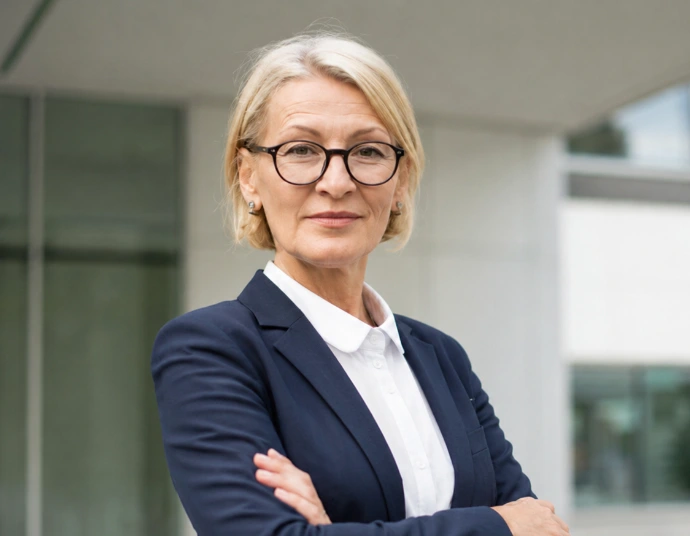
Anke Hoffmann, German Technical Translator
Anke Hoffmann is a German technical translator who wrote documentation for an automation equipment builder before moving to the translation side of the same industry. Eighteen years on, she handles the drawings, controller texts, and quality files that must survive review on both sides of the Atlantic.
Tolerance callouts, finish symbols, and title blocks treated as data, with dimensions and revision letters untouched.
HMI and PLC messages written to the field's character limit, with an abbreviation list your service team approves.
VDA and IATF terminology handled as auditors expect, from control plans to FMEA wording.
How an Electrical Engineer Became a German Technical Translator
Anke earned a Dipl.-Ing. in Electrical Engineering at RWTH Aachen, then worked as a technical writer for a German equipment manufacturer. Her days went into extracting sense from development engineers and turning it into service manuals, parameter descriptions, and controller messages a field technician abroad could act on. She learned there how one German compound noun can carry an entire assembly's function, and how badly it travels when a stranger to the machine translates it.
Translation was the part of that job she liked most, first into English for export documentation, then as a full practice. She has since spent 18 years on German and English technical translation for carmakers' suppliers, automation integrators, and machine tool builders. Colleagues call her the one who reads the drawing first.
Precision the Way German Engineering Documentation Means It
Her specialty is the exactness that DIN-shaped documentation assumes and English-language documentation often leaves implicit. German technical writing separates ratings from measured values, permissible from actual, nominal from effective, and puts the distinction in the noun itself. Flatten it in English and a maintenance limit reads like a design target. Go the other way and an English source saying "the pressure should not exceed" invites a German sentence a reviewer will mark unusable, since that standards culture expects a defined limit value.
The automotive side sharpens this. IATF 16949 and the VDA volumes carry settled German and English wording for the same artifacts, and a supplier quality engineer reading a control plan expects that wording, not a creative equivalent. Anke keeps those pairs locked in the termbase and flags any source term the standard does not recognize.
From a recent job: a machine tool builder's operator panel allowed 20 characters per message field, and the German strings averaged 27. Rather than truncate, Anke built a table of short forms, mapped each to its expansion in the manual glossary, and had the client's service engineers approve it in one call. The panel shipped with readable messages, and those abbreviations now appear in the training material.
What Lands on Her Desk
- Engineering drawings. Notes, welding symbols, general tolerance references, and title blocks, delivered as bilingual tables or reinserted through our drawing workflow. Our page on translating engineering drawings covers the mechanics.
- PLC and HMI strings. Alarm texts, prompts, and parameter names in Excel or XML exports, where one deleted placeholder stops a screen from rendering.
- Service and maintenance manuals. Long files where a naming decision made on page 12 has to hold through 400 pages and a spare parts list.
- VDA and IATF documentation. Control plans, work instructions, FMEA tables, and PPAP packages headed for an audit rather than a bookshelf.
At a Glance
| Language pair | English ↔ German |
|---|---|
| Degree | Dipl.-Ing. Electrical Engineering, RWTH Aachen |
| Certification | Certified technical translator; native German speaker |
| Experience | 18 years translating, after a technical writing career in automation |
| Sectors | Automotive, industrial automation, machine tools |
| Tools | Trados Studio, memoQ, Xbench QA, TIA Portal exports, PDF drawing markup |
How She Sets Up a Project
Her first request is unglamorous: the parts list, the previous version of the document, and any glossary the client's German colleagues already argue about. Internal terminology beats anything she could invent, so she harvests it, cleans the contradictions, and returns the disputed entries as a short decision list.
During production she batches questions twice a week, marks assumptions in the delivered file rather than burying them, and hands the result to a second German-native engineer-linguist for independent revision. Programs for automotive suppliers and factory automation vendors often run for years, and the termbase she maintains keeps document 200 consistent with document one.
Work with Anke
German equipment arriving at a US plant and a US product facing a German customer audit make the same demand: the documentation has to read as though an engineer in the target country wrote it. Send the files through our quote request and name Anke, or ask who else on the translator lineup fits your discipline. Itemized pricing follows within the hour.
Frequently Asked About Anke
Does Anke translate in both directions, German and English?
She does. German is her native language, so English-to-German work is her core output. On German-to-English projects a native English engineer-linguist revises her draft for idiom and register while she guarantees the technical reading of the source.
How does she deal with German text expansion in screens and labels?
She asks for the character limit per field before starting, not after. Where German runs past it, she proposes short forms rather than truncating mid-word, documents each one, and keeps them consistent across the interface, the manual, and the training material. Printed labels work the same way.
Can she handle PPAP packages and FMEA tables?
Yes, and that work fills much of her year. Control plans, process flow diagrams, work instructions, capability studies, and FMEA worksheets follow settled VDA and AIAG terminology, kept in a validated bilingual termbase. Plant shorthand inside those Excel files gets queried rather than guessed.
Is Austrian or Swiss German covered?
Anke writes standard German, which serves technical documentation across Germany, Austria, and Switzerland. Where Swiss conventions matter, the differences are mostly orthographic plus a few trade terms, and we route the file through a Swiss reviser. Name the destination market when you request pricing.